

This is an essay I wrote for the Hoover Commons Dispatch. Chat-John prompt, “give us 3,000 words on principles for a revived international and financial system commons.” There are a few tweaks from the original.
***
The international financial system is a classic commons: It is a public good, beneficial to all who participate.
However, “commons” appears in the index of economics under “commons, tragedy of the.” No individual feels the incentive to provide as much commons as is socially useful. Cows overgraze and grass isn’t tended.
Historically, empire solved this problem. Make them pay for common goods. An idealized view of the postwar order solved the problem by including countries, led by the United States, to a rules-based order overseen by technocratic institutions. That vision has fallen apart. So, what do we do now?
I envision an international financial and monetary commons that operates at a net benefit to the United States. Such a commons can provide its foundation for global prosperity without the need for extensive rules, diminished sovereignty, and multilateral institutions.
Exchange rates
There is a lot of misplaced nostalgia for Bretton Woods. This “rules-based order” failed. It failed in numerous exchange-rate and sovereign debt crises. It fell apart in the face of US inflation, budget, and trade deficits in the late 1960s and early 1970s.
The Bretton Woods system imagines small and balanced trade, a steady price level rather than inflation rate, and balanced budgets. It featured capital controls and rationed foreign currency, to defend exchange rates.
Bretton Woods was designed to stem competitive devaluation with fixed exchange rates. It was not designed as a financial system for large (and desirable) trade and capital flows in a globalized economy. Tying the dollar to gold cannot abide any, even small, sustained inflation, and large trade flows need large capital markets, not just settlement between central banks and gold.
The world moved to floating rates. “Let the market decide” the exchange rate. Governments would no longer waste resources (and enrich speculators) by defending exchange rates. There would be no more speculative attacks and currency crises.
But the move to floating rates was never complete, and now we are in many ways moving back both intellectually and in practice.
Not even Milton Friedman imagined that floating rates would float so much. Moreover, nominal exchange rates move real exchange rates, and for a long time. When the Canadian dollar depreciates relative to the US dollar, a loaf of bread in Windsor becomes cheaper than the same loaf in Detroit, and it stays that way for years. Real relative prices are more volatile under floating than fixed exchange rates. That volatility is harmful to businesses.
The academic literature on exchange rates basically concludes that nobody can tell where exchange rates are going. The currently dominant academic view points to “financial market noise, not economic fundamentals” as the “main driver of exchange rates.” But “noise” is just a word for “we don’t know.” All the usual suspects including interest rates, deficits, monetary policies, or trade flows do not reliably forecast exchange rates nor account for their movements. Friedrich Hayek, who explained that neither academics nor planners will ever have the knowledge to outwit markets, would be pleased. This fact does not stop officials and academics from pronouncing exchange rates manipulated, over- or undervalued, and from trying to move rates in directions they prefer.
The intellectual argument for floating rates emphasizes that governments can artfully devalue and inflate the currency in order to offset shocks. If the price of Argentinian beef falls on world markets, Argentina must export more beef for every car that it imports. Either the price of beef must fall, along with wages paid to ranch employees, or the price of cars must rise. The latter is thought to be better for the economy, though a policy that no price or wage may fall induces a perpetual inflation bias.
But every day can seem to be a crisis needing another devaluation. The more a country pegs or uses foreign currency, the more it precommits not to devalue. Then the country can borrow on better terms. Stronger precommitments are, well, stronger. But pegs invite attack. Currency boards are more secure, but not perfectly. Dollarization or joining the euro is the most irreversible precommitment.
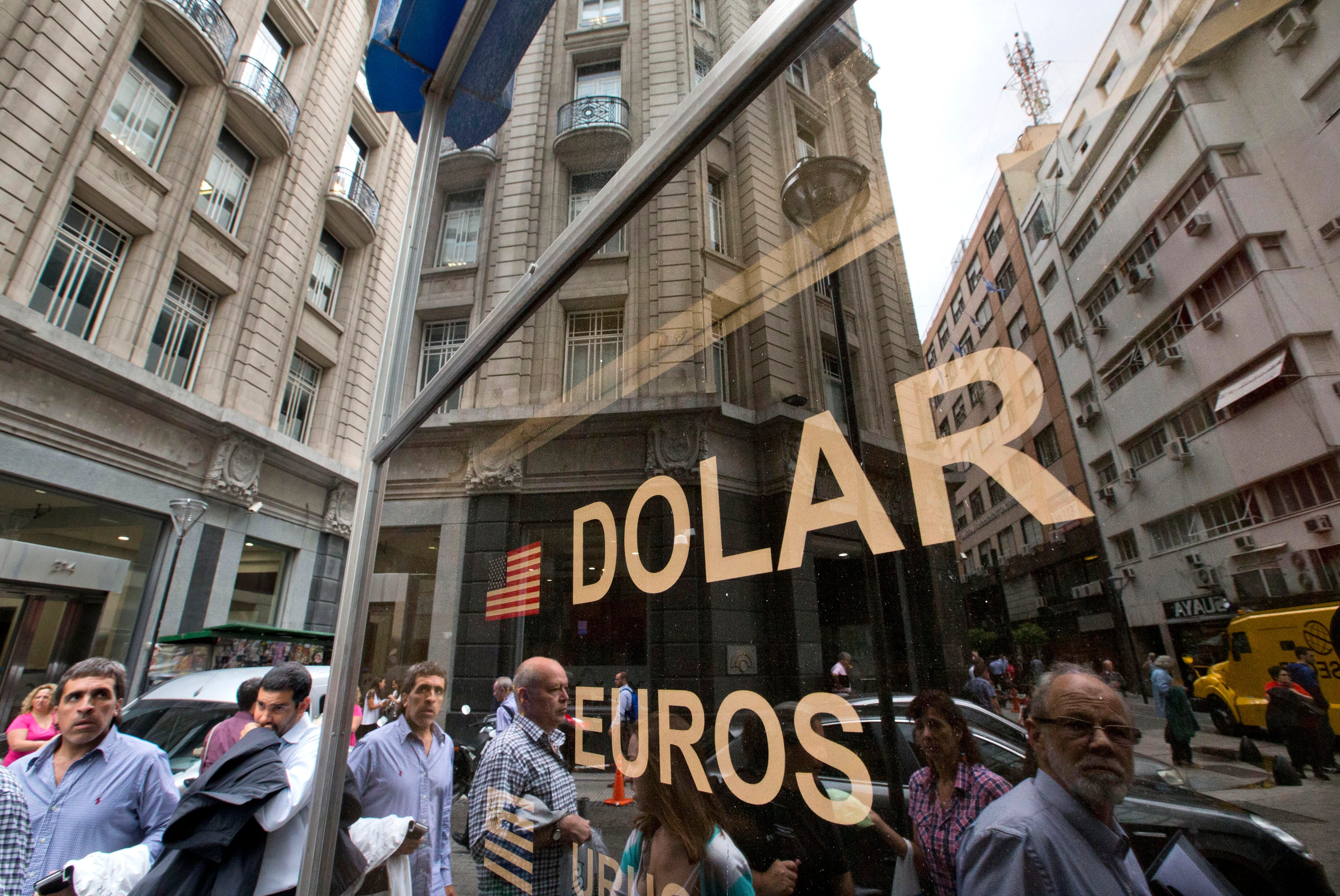
Many countries are slowly and often unwittingly dollarizing. People use more and more dollars, with more or less legal sanction, even while countries maintain their own currencies. Much international trade is invoiced and transacted in dollars, even between countries that have their own currencies. Most corporate and sovereign borrowing that is not in domestic currency is in dollars. The dominant factor of exchange rate movements is the dollar vs. everyone else. In many countries, dollars are widely held and widely accepted for large domestic transactions; local currency is only used for smaller purchases. Part of the Bretton Woods vision was that each country would entirely use its own currency internally. That is vanishing.
More broadly, the world is moving to larger currency areas: the euro in Europe, more use of the yuan, and mooted currency areas in Latin America and Africa.
I view this trend by and large as a good thing. Money is just a standard of value. A widely used standard is a commons. It makes sense for all to use the meter to measure length, hours to measure time, and a common currency to measure value. Using the yard and shortening it an inch in each recession to benefit tailors is not an obviously wise policy.
Dollarization costs and benefits
This observation suggests a policy for the United States to offer the world: Go ahead, use our money, banking, and payment system. But does that open attitude come with costs or unwelcome responsibilities?
Providing the world’s “reserve currency” was once considered “exorbitant privilege.” Now some complain that it is a burden. Is it?
In a modern financial system, listing prices in dollars and making payments via dollar-denominated securities does not require holding a lot of dollars. The unit of account, medium of exchange, and risk-free asset need not stay the same. One could hold euros, buy dollars, and wire the dollars one second later. Or wire eurodollars—dollar-denominated bank accounts that do not use any dollars at all. We could all use Swiss francs, though we can’t all hold large amounts of them. Historically, monetary systems have existed with no supply of the unit of account at all. Many central banks are moving away from dollar reserves to gold, private debt, and other countries’ securities, while still making transactions in dollars.
But for now, there are still a lot of US-issued dollar securities out there, in mattresses as well as in bank accounts and at central banks. That fact gave the United States a one-time benefit. We got to print up a few trillion dollars and send them abroad, in exchange for boats full of goods. It was a benefit, though a small benefit that cannot be arbitrarily expanded.
How could that be bad? Arguably, because we used the bounty to fund government deficits, which it sent to people to consume, rather than to fund productive private investment. Historical analogies in which providing the world’s money undermined long-run prosperity, such as Spain and Portugal when they discovered New World gold, also consumed rather than invested the bounty. If there is a downside to exorbitant privilege, it is our fault.
Contrariwise, would losing reserve currency status be a disaster? Well, it was only a small benefit. And the events that lead to the United States’ loss of reserves status would be calamities orders of magnitudes worse than that loss of status itself. Loss of sterling as reserve currency was a small result of the UK’s malaise, not its cause.
The central danger of increased dollarization is that the United States unwittingly becomes the global lender of last resort and guarantor of foreign sovereign debts.
This process has already begun. In 1990s sovereign debt and currency crises, and again in the 2008 financial crisis, the United States intervened to prevent or mop up after sovereign defaults. In exchange rate interventions (Plaza and Louvre in the 1980s, Argentina and Japan recently) the United States stepped in to prop up foreign exchange rates. The Fed has started offering “swap lines” to lend dollars to other central banks as it lends dollars to US banks in times of stress.
If other countries borrow in dollars, peg exchange rates, or dollarize, they lose the option to inflate and devalue. They must either repay their debts, default, or convince the US to bail them out. When large US banks hold those debts, bailouts are even more likely.
In a dollarized world, foreign banks may make bad investments and suddenly owe a lot of dollars. Their central banks cannot print dollars to help them out. The foreign central banks turn to the Fed. Their governments cannot print dollars either, so if governments bail out banks, the bank crisis can become a sovereign debt crisis.
Bailouts are expensive, and they induce fragility and more bailouts. Bailouts and last-resort loans must come with risk regulation. That’s why the United States regulates domestic banks so heavily. But the United States does not aim for the kind of control over foreign fiscal, economic, and bank regulation policies that could control that temptation.
The answer: Sovereign debt must be considered risky, just like corporate debt. Sovereign default must be countenanced, and not induce a financial crisis. Sovereign debt must be in hands that can bear that risk, in return for suitable reward, as stock market risk is held. It must not be in the hands of too-big-to-fail, systemically important, run-prone, deposit-taking banks. The United States cannot be in the business of bailing out countries and foreign banks that use the dollar, or banks that hold those country’s debts.
This is the central failure of the eurozone. A common currency without fiscal union must allow sovereign default, and cannot concentrate sovereign debt in its banks. Without that understanding, the ECB is stuck bailing out sovereign debts, and sovereigns borrow at will with that protection. European debt and deficit rules proved insufficient, and the United States cannot impose debt and deficit rules on other countries anyway.
The IMF was originally designed to offer temporary help with balance of payments. It evolved to provide help in sovereign debt crises. It can impose “conditionality” of fiscal and economic policies, but it cannot fully stem moral hazard. But the IMF is not and should not be able to bail out and monitor a dollarized world, as evidenced by increasing direct US intervention. Likewise, the international banking community dreams of broad and coordinated regulation under the Basel/BIS coordination, but that whole philosophy is falling apart.
Better to envision a world without bailouts in the first place. But more important, a commons can operate without such institutions.
The Dodd-Frank/Basel approach to stemming bank crises—high leverage, run-prone liabilities, extensive regulation—has arguably failed inside countries. It is hopeless for the United States to apply that kind of regulation to foreign banks that make dollar-denominated loans and take dollar deposits. So the simple answer must eventually bubble to the surface: Risky investments must be financed by equity, securitization, floating-value funds, and long-term debt, not run-prone deposits and short-term debt. Deposit-like claims to dollars must be 100 percent backed. Fortunately, modern financial markets, fintech, securitization, mutual funds and an ample (!) supply US debt make that possible in a way that was not possible when the classic “intermediation” and “liquidity creation” view of banking emerged.
Dollarization is not a panacea. Occasional devaluation in face of shocks can have benefits. As the world moves to more use of common currencies, that option will be less available. “Internal devaluation”—lower prices for beef rather than higher prices for foreign cars—will have to take its place. But wage stickiness and economic contraction is not written in stone. Wages were much less sticky in the past. Much price and wage stickiness results from law and regulation: union contracts, comparable-worth rules, worker protections, and price, wage, and rent controls. Wages change when people change jobs, so dynamic labor markets adjust faster than protected one-job-for-life markets. In much contemporary macroeconomics, sticky prices or wages are the only friction that creates socially undesirable recessions. Macroeconomists write article after article on how central banks and fiscal stimulators should exploit that friction, but next to none on how to oil the friction away. A dollarized world needs that oil.
US states and European countries share common currencies, and must internally devalue in response to shocks. The common answer is, “Yes, but we live in a flexible and dynamic labor and goods market with fiscal transfers.” Well, flexible and dynamic markets can also exist across borders. And once countries realize that devaluation and transfers from Uncle Sam or the ECB are off the table, there is much they can do to hedge external shocks, and build up reserves or credit lines.
Plumbing
The dollar commons is also a financial, payments, and banking commons. Yet the United States is far behind the technological frontier.
Interest-paying safe digital money is technically straightforward. Yet the United States has squashed narrow banks, segregated accounts, money market funds with quick payments via the Fed, central bank digital currency, interest-paying stablecoins, exchange trading of Treasury securities, and other innovations. Those innovations are particularly useful for international transactions, and particularly for small and poorer countries.
The United States also uses its control of the payments and financial system to enact sanctions, debanking, law enforcement, and geostrategic objectives. Much of this activity has important benefits and has been an important success. But it also has costs. Every time we freeze out one actor, it and its fellows have an incentive to construct alternatives. Collecting taxes, stopping hackers, and strangling Tehran and Moscow right now is hard to oppose. But we don’t want to help enforce China’s currency controls and Russia’s tax laws, or incentivize China’s parallel financial system. The US Treasury is well aware of this tradeoff. Let it continue to be so.
The rise of cryptocurrency brings the tension between anonymity and convenience to the forefront, domestically as well as internationally. The continued popularity of $100 bills around the world is testament to the value of anonymity. Interest-paying electronic currency and low-cost transactions would be an enormous benefit, domestically, around the world, and for international transactions. But if electronic currency is as anonymous as cash, it will be a field day for tax evasion, scammers, criminals, sanctions-evaders, and other bad actors.
On the other hand, it would be dangerous for the US government to see and potentially block every transaction anyone makes. Enforcing all our own laws would bring the economy to a standstill. Already, debanking firearm dealers, cryptocurrency firms, payday lenders, cannabis businesses, and Canadian truckers was not obviously wise. Most of all, complete loss of anonymity would be an obvious stake in the heart of political freedom. If the founders heard that was coming, they would surely have rushed to pass an amendment guaranteeing privacy of transactions.
This will be a delicate but not impossible balance, both domestically and internationally. There must be limits on government, such as privately provided 100% backed electronic money that government must subpoena to see records and obtain judgments to block. And government must find as many other ways to stop illegal activity as possible, rather than trample the commons.
Busybodies and bad ideas
A successful commons must defend against bad ideas too. I have mentioned a few. A few more loom.
A chorus of macroeconomists, often affiliated with international organizations such as the G7, G20, IMF, World Bank, BIS, OECD, or Basel Committee, proclaim the necessity of policy coordination and supranational regulation for the functioning of the commons. They diagnose “imbalances,” “overcapacity,” “undervalued” or “overvalued” exchange rates, “predatory competition,” savings “gluts” or investment “shortages,” “excessive debt” and “excessive deregulation,” and other unknowable and economically meaningless terms, and proclaim remedies. Some countries, including the US also push for addressing “imbalances,” and I suspect many are accommodating that strong pressure. I put it all in scare quotes as these are all economic fallacies. Markets clear, absent price controls, but maybe at prices and quantities you don’t like.
For example, China saves and invests. The US borrow and consumes. That difference produces a trade flow. Peel aside the money, and China must save by putting things on boats, in the hope that someday we will return the favor. The economists’ report to the G7 recommends that China “rebalance” toward consumption to eliminate that flow. I can only imagine how Xi Jinping and company chuckle. Sure, we’ll sharply raise taxes, borrow unsustainably, enact half-of-GPD welfare states that pay our citizens not to work, and suffer your miserable growth rates.
If the United States and Europe do not like how saving and investment affect trade, perhaps the United States and Europe should rethink our subsidies for consumption and our taxation and regulatory chokehold on savings and investment.
Everyone ignores these proclamations, so they may appear harmless. But bad ideas can spread, and undermine simple good ones.
There are many temptations to capital controls. Controls became popular after the East Asian crisis. Yet countries that try to control “sudden stops” find few want to go. Political limitations on capital and investment privileging US investors and institutions are tempting. Troubled sovereigns are tempted to force institutions to hold their debt. All of this muddies the commons. At least we (policy geeks, and the US) could loudly proclaim mud.
Some wish for a world with small trade and capital flows. Large flows are often good! Some countries have good development prospects—US railroads in the nineteenth century and AI today—and inadequate saving. Other countries have poor development prospects and large savings. Sad to say, that must be China today, or it would not be investing abroad so much. Capital should flow from the latter to the former, which means putting things on ships. As it is better for US cities and states to specialize, so it is better for countries to specialize. For decades, economists puzzled that the world did not trade as much as our models said it should. Once the world started acting like our models, economists and officials quickly proclaimed “gluts,” “predation,” and “overcapacity.”
An open, integrated market for capital, goods, services, and human talent, supported by a financial, banking, and currency commons, improves human welfare. And it also can improve the welfare of the leading country, hopefully the United States.
Doctor, heal thyself
In the end, the gradual adoption of international currencies and payment system is happening on its own. The question is, will it be the dollar and US system, or something else?
The United States can do a lot to make our commons more attractive. Bouts of inflation that wipe out wealth of bond and money holders drive people away. Any default, rescheduling, financial repression, or special taxation of US debt will drive others away. Both considerations require the United States to fix its out-of-control fiscal path. Rule of law, equal apolitical treatment, and a fair and efficient judiciary—even for foreigners—attract them. People join the party when the house is in order, and a clean house is the best invitation to a party.