

The recent Piketty-Saez-Stiglitz revival of wealth taxes, ostensibly to improve the lot of the poor, makes many mistakes. I’ll focus on one: the difference between wealth and consumption. The poor wish consumption. Turning capital into consumption must destroy the capital that produces consumption. Taxing wealth in the name of inequality will make the world, including the poor, much poorer.
Why should billionaires live high on the hog while so many still live such wretched lives? “Tax the rich, feed the poor / Til there are no rich, no more” sang the rock band 10 Years After in 1971. It’s a centuries-old answer looking for new questions. (They made a lot of money on that song! The song is more like Lennon’s “Revolution,” expressing some skepticism. I remembered the lyrics as “till there are no poor no more,” but the actual lyrics are more accurate descriptions, both of the intention and the likely effect.)
However, the vision of high lifestyle amid destitution imagines great inequality of consumption. The current outrage, and demand for confiscatory taxation, is over inequality of wealth. (And that, largely mark-to-market wealth driven by high prices.) There is a big difference.
The hard fact: Our billionaires, and now trillionaire, own wealth that is almost exclusively stock in companies they created. That wealth is almost entirely left reinvested in those companies. And the companies produce great products, innovate, and employ thousands. Just what is the problem, you might ask, but that’s not our point today.
For example, suppose Elon Musk consumes $10 million a year. It’s hard for any human to consume that much. Still, that’s 1/1000 of 1% of a trillion. At 10% per year, Musk earns that much in less than an hour.
The wealthy do not swim in Scrooge McDuck pools of money that can be handed out. And even if they did, that money, redistributed, would swiftly drive up prices rather than feed everyone. Musk’s trillion is not the ready inventory of a huge grocery store that can be handed out to feed people. And if it were, once the store was empty, the poor would be hungrier again, and there would be no store to buy from.
What would the government do if it took over Musk’s SpaceX stock? At best, the government would use SpaceX earnings to buy and hand out, say, food, rather than invest in the company. Others must then produce food and not rocket ship parts. That means reorienting the productive capacity of the economy away from investment and to consumption. It means less capital going forward. Certainly no rocket ships or AI, and all the benefits those stand to bring.
But most of SpaceX value is not a stream of profits like a railroad’s. Most of its market value is investor’s hope that in the future SpaceX will dream up new and profitable ventures. That value would go poof the minute the government took it and stopped investing. It may go poof anyway.
Perhaps you think the government, by taxing Musk and demanding cash, can force Musk to sell his stock to others who won’t implode SpaceX’s value. But where do others get money to buy SpaceX stock? In the end, it must come from other company’s earnings that won’t be invested in other companies. Again, the economy reorients from investment to consumption. Tax the rich feed the poor, till there are no businesses no more.
Perhaps you think the government can manage SpaceX “for people, not for profits.” It used to. And NASA, though one of the best government agencies, was never able to do what SpaceX can do. Socialism never did turn much of a profit for consumers.
The world’s rich consume very little of their wealth. The worlds’ poor consume a lot of whatever they have. Being poor is not fun. If we split up Musk’s $1 trillion and gave about $100 in Tesla stock to each of the world’s nearly 10 billion people, it’s a good bet they would not be content to consume only 1/10 of a cent extra per year.
There are plenty of other reasons that wealth taxation will not help. Even the billionaires’ wealth, even if it could be transferred and consumed without destroying the seed corn of our economy, is trivial.
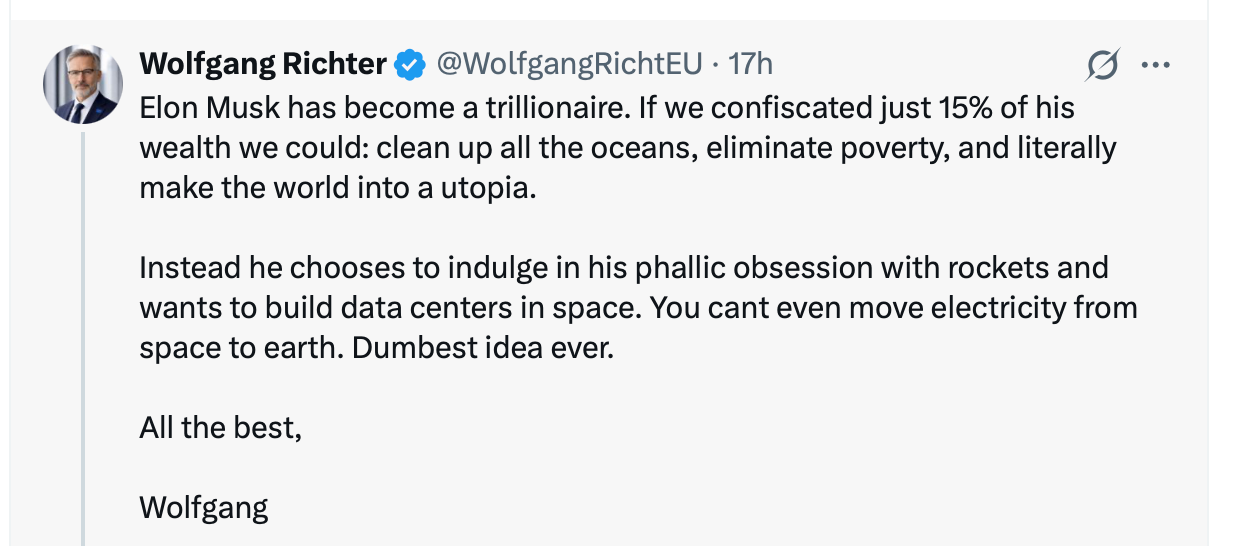
This is simply false, and innumerate. 15% of a Trillion is $150 billion. The US alone spends $1.8 Trillion on anti-poverty programs each year, to little effect.
The biggest reason it will not work is the simple one: incentives. If you tax wealth, you tax the activities that create wealth.
Taxing billionaires is not enough. Piketty, Saez, and Stiglitz now want the rest of us to “degrowth” in order to transfer resources to the poor. That doesn’t add up either. Degrowth means producing less too. What are the poor to eat? Penury and depopulation used to be embarrassments of the socialist left. I guess they now features.
I too would love to raise the prosperity of the world’s poor. The goal is not the issue. The issue is whether the wealth tax will help or hurt.
What helps? This graph from Max Roser at Ourworldindata makes the point beautifully:
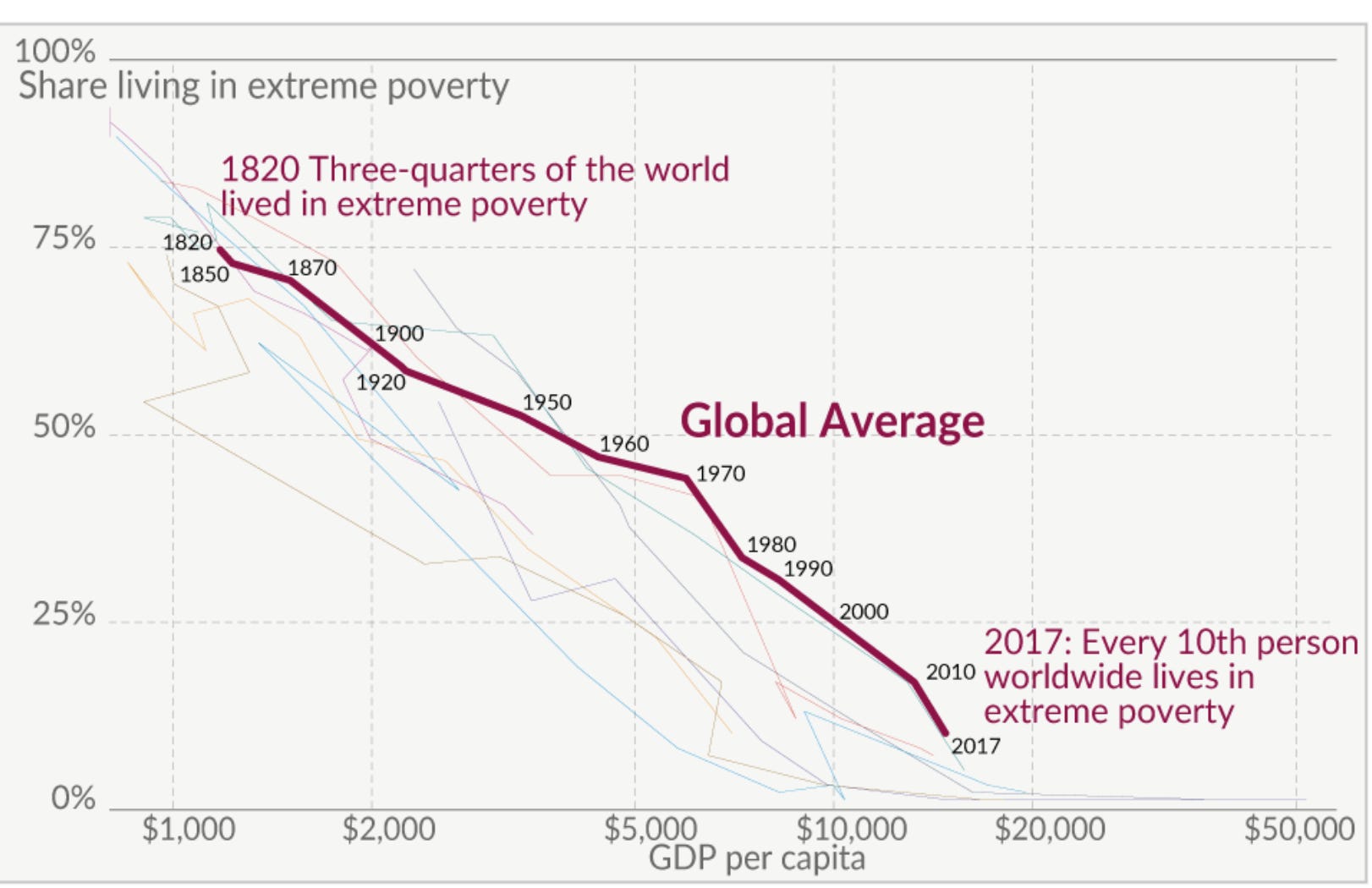
The x axis is GDP per capita, not time. The y axis is the share living in extreme poverty. In fact, our lifetime has seen the greatest decline in global inequality and global poverty ever seen. What helps the poor? Growth. Capitalism and growth. Degrowth and wealth taxation will push us right back up that slope.
(Thanks to a tweet by Cliff Asness, which I cannot find, where I got this idea.)
The motive for the wealth tax is envy.
Oh, by the way, Piketty wants to cap growth at $68,000 per capita, PPP adjusted. That happens to be the GDP per capita of France. Gee, what a coincidence!
I fail to see how govt spending another $1 trillion is going to improve the US economy more than letting Musk invest $1 trillion directly into the economy. People like Warren, Bernie and Mandummy believe in fantasy.