Wealth tax equilibrium accounting
The recent Piketty-Saez-Stiglitz revival of wealth taxes, ostensibly to improve the lot of the poor, makes many mistakes. I’ll focus on one: the difference between wealth and consumption. The poor wish consumption. Turning capital into consumption must destroy the capital that produces consumption. Taxing wealth in the name of inequality will make the world, including the poor, much poorer.
Why should billionaires live high on the hog while so many still live such wretched lives? “Tax the rich, feed the poor / Til there are no rich, no more” sang the rock band 10 Years After in 1971. It’s a centuries-old answer looking for new questions. (They made a lot of money on that song! The song is more like Lennon’s “Revolution,” expressing some skepticism. I remembered the lyrics as “till there are no poor no more,” but the actual lyrics are more accurate, both of the intention and the effect.)
However, the vision of high lifestyle amid destitution imagines great inequality of consumption. The current outrage, and demand for confiscatory taxation, is over inequality of wealth. (And that, largely mark-to-market wealth driven by high prices.) There is a big difference.
The hard fact: Our billionaires, and now trillionaire, own wealth that is almost exclusively stock in companies they created. That wealth is almost entirely left reinvested in those companies. And the companies produce great products, innovate, and employ thousands. Just what is the problem, you might ask, but that’s not our point today.
For example, suppose Elon Musk consumes $10 million a year. It’s hard for any human to consume that much. Still, that’s 1/1000 of 1% of a trillion. At 10% per year, Musk earns that much in less than an hour.
The wealthy do not swim in Scrooge McDuck pools of money that can be handed out. And even if they did, that money, redistributed, would swiftly drive up prices rather than feed everyone. Musk’s trillion is not the ready inventory of a huge grocery store that can be handed out to feed people. And if it were, once the store was empty, the poor would be hungrier again, and there would be no store to buy from.
What would the government do if it took over Musk’s SpaceX stock? At best, the government would use SpaceX earnings to buy and hand out, say, food, rather than invest in the company. Others must then produce food and not rocket ship parts. That means reorienting the productive capacity of the economy away from investment and to consumption. It means less capital going forward. Certainly no rocket ships or AI, and all the benefits those stand to bring.
But most of SpaceX value is not a stream of profits like a railroad’s. Most of its market value is investor’s hope that in the future SpaceX will dream up new and profitable ventures. That value would go poof the minute the government took it and stopped investing. It may go poof anyway.
Perhaps you think the government, by taxing Musk and demanding cash, can force Musk to sell his stock to others who won’t implode SpaceX’s value. But where do others get money to buy SpaceX stock? In the end, it must come from other company’s earnings that won’t be invested in other companies. Again, the economy reorients from investment to consumption. Tax the rich feed the poor, till there are no businesses no more.
Perhaps you think the government can manage SpaceX “for people, not for profits.” It used to. And NASA, though one of the best government agencies, was never able to do what SpaceX can do. Socialism never did turn much of a profit for consumers.
The world’s rich consume very little of their wealth. The worlds’ poor consume a lot of whatever they have. Being poor is not fun. If we split up Musk’s $1 trillion and gave about $100 in Tesla stock to each of the world’s nearly 10 billion people, it’s a good bet they would not be content to consume only 1/10 of a cent extra per year.
There are plenty of other reasons wealth taxation will not help. Even the billionaire’s wealth, even if it could be transferred and consumed without destroying the seed corn of our economy, is trivial.
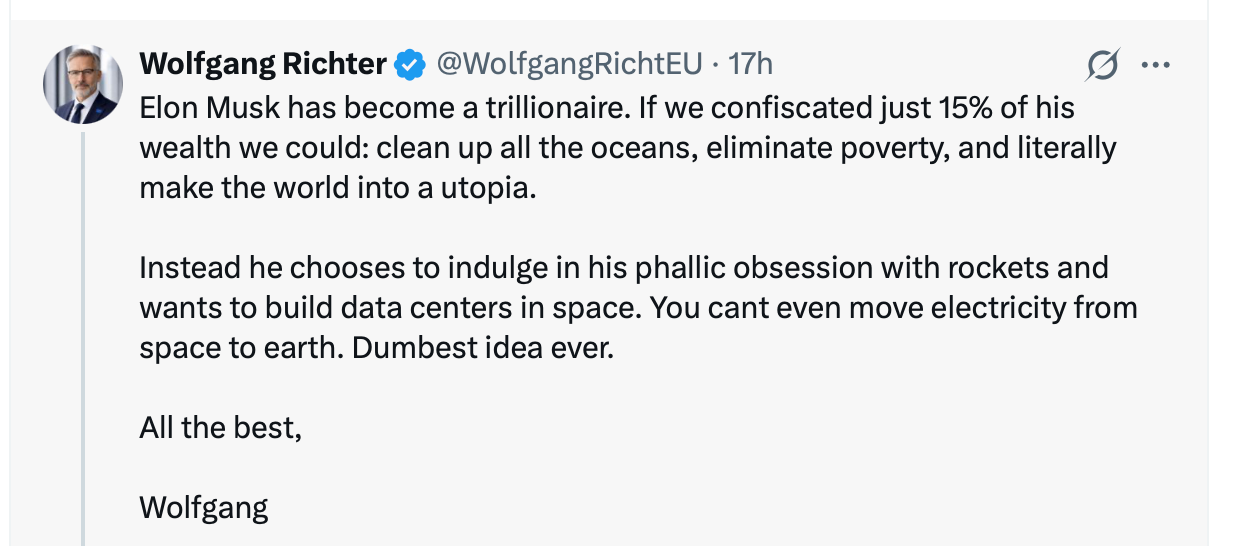
This is simply false, and innumerate. 15% of a Trillion is $150 billion. The US alone spends $1.8 Trillion on anti-poverty programs each year.
The biggest reason it will not work is the simple one: incentives. If you tax wealth, you tax the activities that create wealth.
Taxing the billionaires is not enough. Piketty, Saez, and Stiglitz now want the rest of us to “degrowth” in order to transfer resources to the poor. That doesn’t add up either. Degrowth means producing less too. What are they to eat? Penury and depopulation that used to be embarrassments of the socialist left. I guess they now features.
I too would love to raise the prosperity of the world’s poor. The goal is not the issue. The issue is whether the wealth tax will help or hurt.
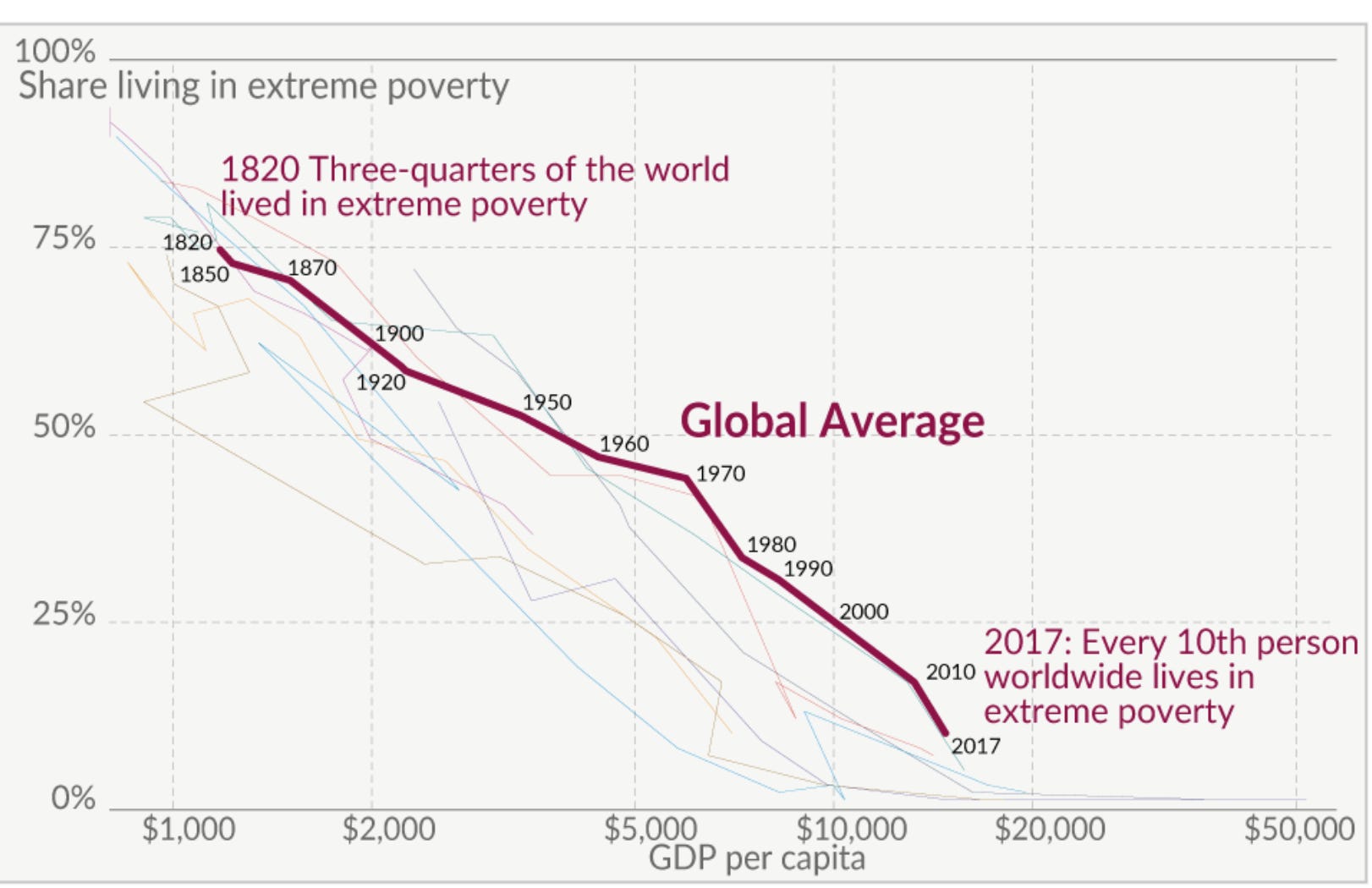
What helps? This graph from Max Roser at Ourworldindata makes the point beautifully
The x axis is GDP per capita, not time. The y axis is the share living in extreme poverty. What helps the poor? Growth. Capitalism and growth. Degrowth and wealth taxation will push us right back up that slope.
(Thanks to a tweet by Cliff Asness, which I cannot find, where I got this idea.)


A week or two ago, in response your piece about income inequality as discussed in the WSJ, I responded with exactly this point, "... .Second, the appropriate measure of inequality is consumption rather than wealth."
Glad you are correcting your previous oversight. Better late than never!
All this uproar about wealth taxes in the US ( or world wide ?) when in fact we already have significant wealth taxes in the United States ( to stick with one example): called "property" or "real estate" taxes imposed by towns, counties, and other municipalities. So, surely you would argue to abolish those ( if you are opposing new, more comprehensive wealth taxes). Ironically, wealth taxes in the US in fact contribute to inequality, because they are used to pay for the services locally provided by schools ( public and at least partially also for private ones) and other municipal services like garbage collection and enforcing property rights and protecting property ( fire departments, police ) sometimes called public safety which to some degree also is supposed to enforce rules of conduct ( not to endanger other persons beyond what is acceptable by "legal codes" defining personal and civil rights. I am trying to be as abstract as possible.
Why do these property taxes strengthen inequality rather than mitigate it? Because wealthy individuals tend to move to areas where they get the school and property enforcement and protection they demand, and are willing to pay for those with a proportion of their real estate wealth ( and may also preserve them by supporting local political, school board and judicial positions to reflect those preferences). Less wealthy individuals end up in districts with lower quality of educational services, property or personal protection. The latter tends to reduce the chances ( opportunities; is there an equality of opportunities in the United States?).
Therefore a wealth tax is not necessarily redistributive, in fact it can be the source of the exact opposite.
In your essay you equalize any taxation of wealth as growth reducing or even eliminating. That does not apply to property taxation?
You also state that wealth is not equal consumption. Yes, they are 2 different things. However, there is some relationship, at least in certain aggregations. Friedman's permanent income hypothesis states that as a first approximation consumption is a "constant" or at least only slowly changing fraction of overall wealth. The flow ( consumption) is seen as a proportion "k" of the stock wealth approximating what the late Milton Friedman calls permanent income, not a bad name it seems. Therefore taxing consumption per se is not a solution for raising revenues to deliver services either then.
Economists always want taxes that they call the least distortive to economic activity ( in some perfect abstract world where common services are not needed or provided freely without resource cost).
In that economic model the only non-distortive tax is a lump sum tax which is neither related to wealth, consumption, production or income. With unlimited borrowing such a lump sum tax could be a periodic lottery where the lump sum each person in the "jurisdiction" pays is determined by a game of chance which distributed the overall tax revenue needed in a random way. Why not?
So much to the heroic claims made about wealth creating "productive" investments ( that would include inherited wealth and that gained by a lottery).
If those investments are simply to dig a hole on one day and closing the hole the next day, then those investments are not necessarily "Productive". The resulting "plant" is non-existent and might only help some worms and somebody's accumulating muscles.
If the wealth is invested in plants using fossil fuels as an energy source and are emitting methane unchecked ( like most cows do), then these investments in plants and cows can potentially in some scenario literally destroy the inhabitable earth ( inhabitable for humans that is disregarding pets and other creatures for the moment). If that were true ( just hypothetically) then we could tax that wealth used to invest in those activities to mitigate, neutralize or better reduce such investments.
Lots of activities captured in GDP are simply actions to fix or reduce the damage caused by such investments ( and as such are productive), while the damaging part of the investment is not recorded as a negative ( humankind might have accumulated negative wealth by reducing the ozone layers around the globe). Hypothetically!
Is GDP/Capita a measure of productivity? A significant portion is not ( at least acknowledge that that is possible).
Simple examples are "overinvesting"in housing ( like China presumably did), although I acknowledge that a precise definition of overinvestment is difficult ( however constantly claimed by many serious economists). Ok, China is certainly not a fully competitive "Capitalistic" market economy. Which country is ? The US? The US federal government is paying investors in electricity generating wind capture projects almost one billion USD ( adding them all up). Are wind power plants productive investments- looking at states like Texas they certainly are ( and do is solar in Texas: producing electric power when needed the most: in summer for Air conditioning and so on).
Are tar sand projects in Alberta, Canada productive investments ? According to some calculations ( I will need to find those citations again) Canada and the US ( the latter as consumers and refiners of this tar to convert tar into oil and then use pipelines to transport the resulting products) the whole process of digging out, transporting and refining tar sand into useful fossil fuel takes more energy than most uses of that energy get out of the resulting refined products!
Productive investments? By the "private sector"? Alberta is so fearful that the central Canadian government may one day discover the energy wasting and environmentally dangerous activity that Alberta is having a referendum to split off from Canada!
The crux in my view is to view all wealth --> investment --> desired consumption as "productive" in some abstract economically super efficient model while totally ignoring the framework that makes an economic "jurisdiction" often loosely called a "country" actually function as such: the costless supply of a legal, consensus building political entity with social cohesion that can "produce" such outcomes within that jurisdiction and in cooperation ( hopefully not war like "cooperation, I.e. attempted coercion) --> such a costless supply simply does not exist anywhere on this globe. Striving to find models of jurisdictions with institutions and norms that generate productive outcomes without damaging other jurisdictions or the global environment ( only as an example: there are other global elements needed like voluntary organisations and institutions which allow consensus building on global concerns such as infectious deseases and peace building processes, and so on).