

Is there a coherent story in which the Fed should lower interest rates now? Even more, is there a story in which the Treasury should deliberately shorten the maturity structure and then the Fed lowering interest rates reduces inflation?
There is. It’s in the equations of my own best models. Which puts me in a quandary: Do I really believe the result, or do I hope that more work will overturn it?
(These thoughts are brought on by recent tweets and papers by Saki Bigio and Eric Mengus advocating lower rates for related reasons. Links below.)
What happens if the Fed raises or lowers interest rates and fiscal policy does not change? Italics, as that is the important and usually overlooked part of the question. Most models and authors presume that if the Fed raises interest rates, Congress raises tax revenue or cuts spending to pay the added interest costs on the debt. And that usually happens. We ask now, what can the Fed do all by itself?
I’ve been thinking about that question largely from the point of view of raising interest rates. Here is my best answer, taken from Inflation and Debt.
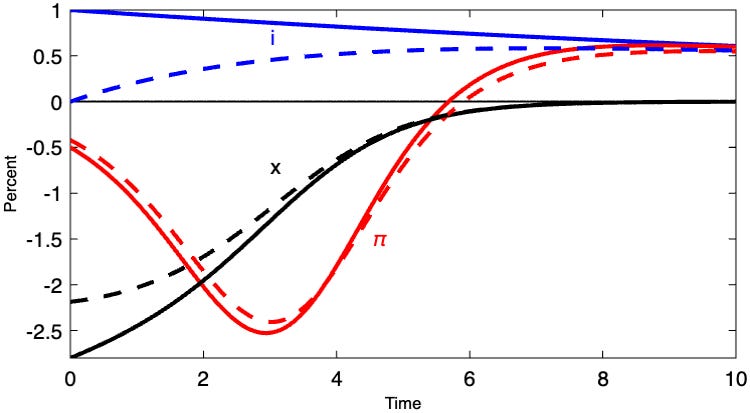
i is the interest rate, x is output, pi is inflation. Higher interest rates lower inflation, and with a lag not just an instant downward jump. Higher interest rates eventually raise inflation, however. My usual warning is thus “unpleasant interest-rate arithmetic:” Without tighter fiscal policy, monetary policy can only rearrange inflation, buying less inflation now by more inflation later. Unless fiscal policy finally gets around to solving its deficit problem. Along the way, higher interest costs on the debt add to the fiscal pressure for inflation.
The dashed lines represent the same experiment, but with the usual slow rate rise cycle rather than an instant upward jump. As you can see, that doesn’t make much difference. The key is a persistent rate rise that lowers long-term bond yields.
(The graph is Figure 6.3 p.99 of Inflation and Debt, and the calculations are in Inflation Dynamics with a Generalized Phillips Curve. It’s the response to the indicated interest rate paths, with a standard IS curve, the generalized version of the Lucas Phillips curve, long-term debt, and no change to fiscal surpluses.)
Now, inspired by Bigio and Mengus’ courageous willingness to stand up and say that something the current administration wants might not be totally idiotic, consider lowering interest rates. The result is, of course, just the previous graph upside down.
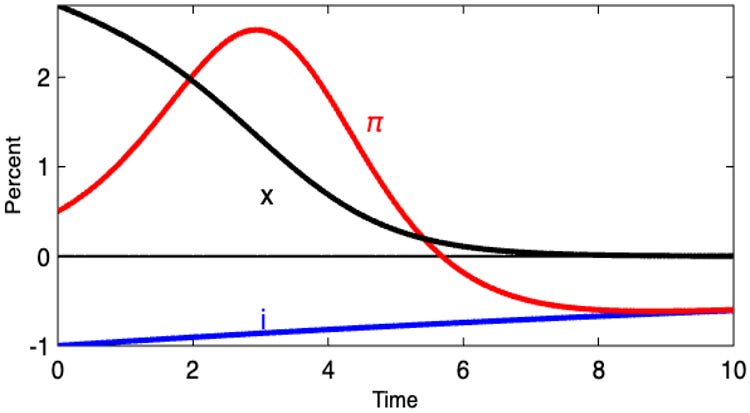
In the short run you get the conventional story: lower interest rates raise inflation and boost output. However, that turns around in the long run. Lower interest rates eventually lower inflation. Rather than focus on the short run with the long run as an unfortunate consequence, maybe we should focus on the long run with the short run as a difficulty to overcome.
The latter “Fisherian” result, that lower interest rates eventually lower inflation, has been a thorn in my side since I noticed it about 10 years ago. It’s present in standard new-Keynesian models too. It’s robust and hard to get rid of. It takes two basic ingredients: long-run neutrality and long-run stability. “Neutrality” means that in the long run nominal interest rates and inflation go together. Perpetual 50% inflation must mean 52% interest rates or thereabouts. That’s pretty hard to argue with. “Stability” means that inflation will eventually end up where the Fed puts the interest rate. That’s easier to argue with, but economic theory screams it, and so does the experience of the long zero bound. That central bankers and policy people look at you like you’re crazy for saying it doesn’t necessarily mean it’s dumb. It’s a long-run result, and central bankers don’t often see long runs.
Indeed, in the models I played with for a long time, higher interest rates led to higher inflation right away. Getting inflation to go down at all in the short run took work, and getting inflation to go down slowly took more work. I heaved a sigh of relief when I finally got this far, in which inflation goes up temporarily before going down. That ought to dissuade enthusiasts from arguing that one should lower interest rates to lower inflation. Sure, but you have to wait out the inflation surge first, and you’re not likely to keep your job if you do that.
However, my little model relies crucially on long-term debt to get inflation to go up before it declines. Here is the same model with one small change: The government only issues overnight debt:
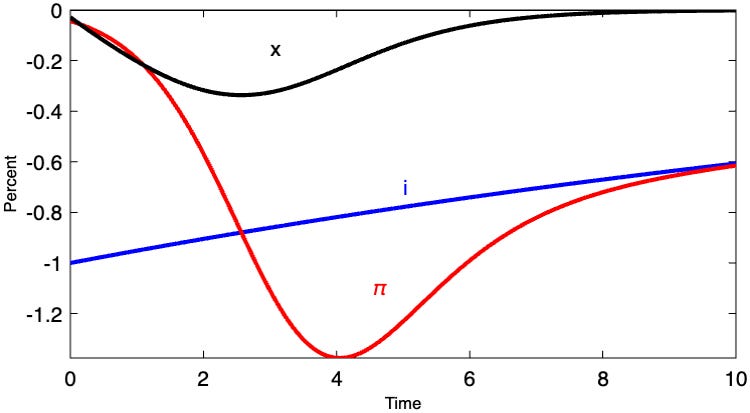
Now lowering interest rates brings inflation down both in the short and long run!
So, finally, I get to the point: Suppose you’re a government, and you want lower inflation. You face the unpleasant possibilities outlined by the first two graphs. Well, reprogram the simulation. Why not first buy back all the outstanding long-term bonds and issue short term bonds instead? Now you get the option of the third graph!
Lower interest rates not only bring down inflation through the Fisher mechanism. They also lower interest costs on the debt, which lowers the fiscal pressure. This is the opposite of the Eduardo Loyo mechanism that bedeviled Brazil.
In sum, in this model, the best I know of to address this sort of question, the government should first drastically shorten the maturity structure of debt, and then lower interest rates persistently. Inflation will come down directly.
Buying back all the long-term debt at low prices and then disinflating also makes a lot of money for taxpayers. It has all the benefits in reverse of the policy I was arguing for in the 2010s, rolling all the debt into long-term bonds to lock in low rates.
Maybe Bessent and Warsh are cleverly working together!
The economist’s conundrum
So why am I writing a blog post and not a WSJ oped arguing for even larger treasury purchases and then lower rates? Well, here is the conundrum. The result is clear in the model. But do I “believe it,” whatever that means? Well, only sort of. In 10 years of wrestling with it, I have come to believe the long-run proposition. Lower interest rates forever, and everything else constant (in particular the government does not go on a borrowing and spending binge) inflation will eventually decline. Eventually. I also mostly “believe” the first two graphs. Monetary policy can have the usual effects in the short run before becoming neutral, stable, and Fisherian in the long run. And I believe the overall lesson: That’s a contingent result. There are episodes in which higher interest rates have raised inflation.
Where my faith comes up shy is to believe that by reducing the maturity structure of the debt, the government can reliably eliminate the short vs. long run tradeoff. I keep hoping for some more general model with some better mechanism to make inflation go the wrong way in the short run. But I don’t have one. Now, I know the dangers of reasoning by intuition outside of a model, by reasoning that surely somebody will build a model in the future that validates intuition. But I also know the dangers of reasoning that takes a given model seriously and literally.
Should I have more courage? Think of the great economists who reasoned far outside of conventional wisdom based on their model. Milton Friedman, in 1968, used theory alone to deduce that there was no permanent tradeoff between inflation and unemployment, never mind Phillips’ celebrated empirical curve and the unanimous professional opinion at the time. He stood up in front of the whole American Economic Association, and said that if the government tries to lower unemployment by accepting inflation, it will only get more of both. They laughed. He was spectacularly right. But of course we can also think of the hundreds of economists who offer policy advice based on simple models, only to discover that the models were too simple and they left something out. I only wish I knew what that something was.
The larger question: how quickly should new economic theory make it to policy? I generally think economists are too quick to advocate policy based on new theory. We’ve seen many theories come, shine bright for a while, then be discovered to have fundamental problems. The same holds for “facts.” This caution holds especially given that policy seems to have a hard time implementing tried and true simple theories like free trade, no price and rent controls, and so forth. The Fed rightly has moved cautiously on some of the wilder predictions of new-Keynesian models and those are 30 years old. Thank goodness it did not implement MMT. On the other hand, conventional wisdom often gets stuck in a rut, and needs a simple theory to get out. Friedman 1968 is the great counterexample.
Two things I know for sure: Nobody else really knows. And the standard view of a mechanistic relationship between inflation and interest rates is wrong. Any power of higher rates to lower inflation is fleeting and contingent. Contingent on just what is an interesting question. It is a lot more possible that this model is right than you might have thought.
Bigio and Mengus
Saki Bigio and Eric Mengus make related points. Bigio writes on x.com here, ablonger essay here, and in the paper “Sticky Inflation: Monetary Policy when Debt Drags Inflation Expectations” with Nicolas Caramp and Dejanir Silva. Eric Mengus writes on x.com here, and in the paper “Fiscal Dominance: Implications for Bond Markets and Central Banking” with Jean Barthélemy and Guillaume Plantin.
Both are, like myself, attuned to today’s crucial question, what can the Fed do without a change in fiscal policy, under the gun of large debt and deficits, in the face of a skittish bond market? Bigio:
raising rates without any commitment from the Treasury to restrain deficits cannot resolve anything
Bigio’s advice:
The Fed should do quite the opposite: lower rates and front-load inflation into the present.
That looks a lot like my second graph.
The model seems presumptuous that government can set the interest rate and fund the government at that rate. Why would we believe this?
Consider the extreme case of the funds rate being set to zero. When the US government auctions hundreds of billions of bills, the market is going to bid a non-zero interest rate. The alternative is the central bank prints money to buy the government debt offering and this money printing makes bonds less desirable.
I think it is an interesting test of monetary policy to have Treasury issuing debt at the short end all while the central bank claims the power to set the overnight funding rate. Maybe the market will accept the fairy tale on interest rates. Will asset prices / inflation confirm this story or press higher?
Frankly, I think the politicians and government paid economists believe in the free lunch and this idea of funding government with short term debt / loans is proof. Rather than reduce the debt burden by cutting spending, we have financial engineering. Even if it works in the short term, eventually the market is going to be stuffed to the gills with bills and demand a much higher interest rate to buy more of them.
It would be nice if you would address things like this https://www.reuters.com/business/trump-says-if-fed-doesnt-cut-rates-hell-stop-trading-with-some-nations-2026-09-04/ with the same scorn and ridicule you would had someone on the left said something similar.