

Inflation is stubbornly high, and the Fed mulls whether to raise rates. What does current economics say about the central question: How does raising interest rates affect inflation?
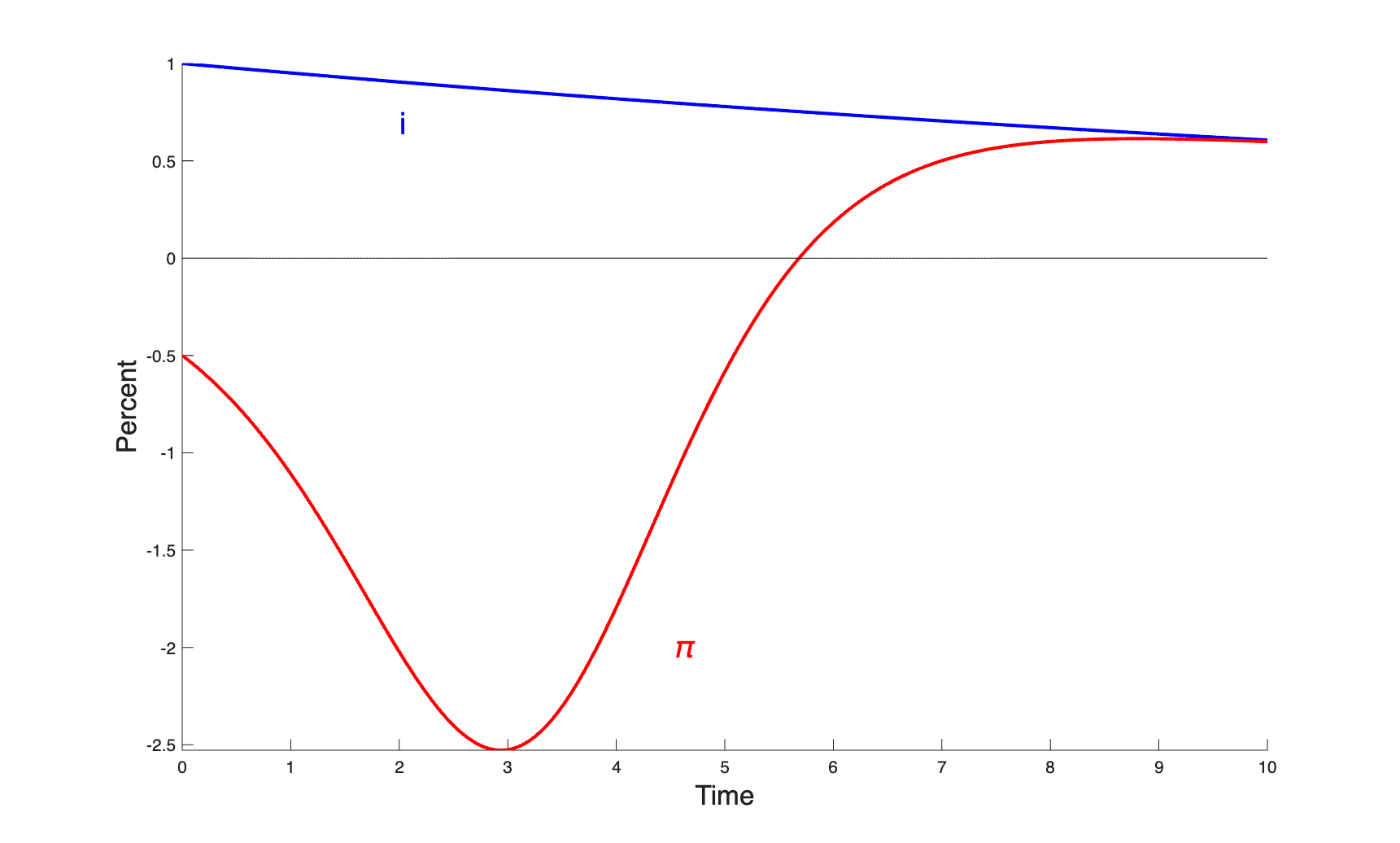
Here is the best one-graph answer I have to this question, taken from a recent paper (also summarized in “Inflation.”) i is the interest rate, 𝜋 is the inflation rate.
The simulation begins in a conventional way. The higher interest rate pushes inflation down, going forward. Duh, you may say, I didn’t need economic theory for that. Higher interest rates lower output and employment and lower output and employment through the Phillips curve bring down prices and wages. The simulation sort of looks like the Great Data Point, 1980-1982, which dominates historical experience. Let’s get on it and raise rates, Mr. Warsh, you may say.
But then inflation turns around. In the long run, higher interest rates raise inflation. And, conversely, lower interest rates lower inflation.
Here you might say I have gone off my rocker, but you’d be wrong. This is a robust and nearly inescapable conclusion of basic economic theory, and it is a part of every (well, every one I know) contemporary economic model. It’s not that well recognized. Most modelers focus on the short run and don’t ask models what happens if interest rates rise and stay high. But it’s there.
The prediction comes from two central underlying propositions. First, the economy is neutral in the long run. This just means that real things don’t depend on units of measurement. Physics is the same in meters or feet. Economics is in the long run the same in dollars or yen. Today’s real purchasing power and employment is essentially the same as it would be if the dollar were worth the same amount as it was in 1947, rather than 6.3 1947 cents. (It is.)
Neutrality means in the long run a higher nominal interest rate must correspond to higher inflation, not a permanently higher real rate of return. Countries with high inflation have high interest rates. A positive correlation of interest rates with inflation also dominates US history.
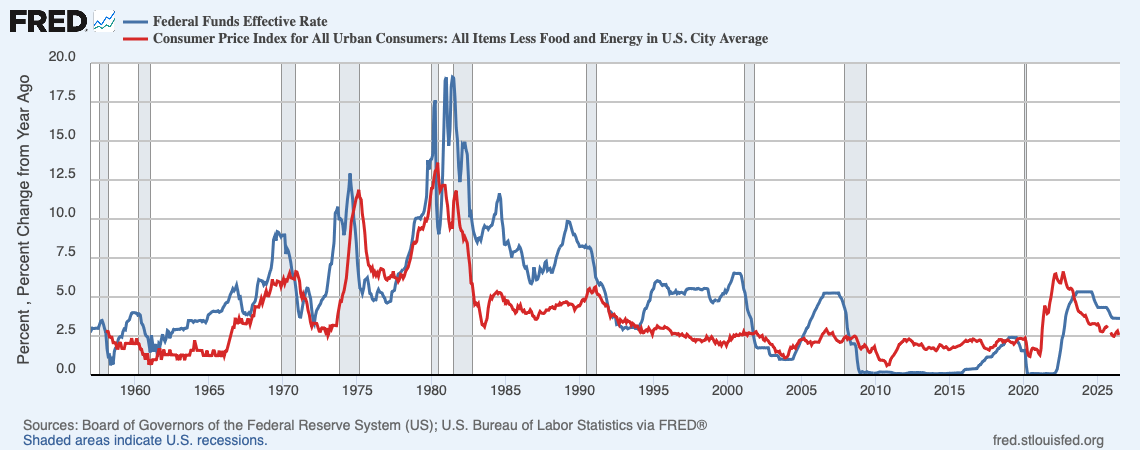
Now, 1960s economics acknowledges neutrality, but holds that the instability you see in the first graph lasts forever. Interest rates and inflation move in the same direction because central banks quickly move interest rates to follow inflation, like a seal balancing a ball on its nose, not the other way around.
1970s economics, which made it to interest rate targets in the 1990s says no, and adds the second fundamental proposition: The economy is stable under an interest rate target.
If the economy is stable and neutral in the long run, there is not much you can do about it: higher interest rates eventually raise inflation.
Practical people rebel, but practical people have little experience with the long run. Economics is really helpful to sort out long run propositions. And a lot of evidence, especially the stability of inflation at the long quiet zero bound, argues also for long-run stability. (“Inflation” again is my latest summary.)
Summing up then, my top graph illustrates the basic and robust conclusion of today’s baseline economics: In the short run, higher interest rates drive inflation down. but the economy eventually becomes stable and neutral in a long enough run, and higher interest rates eventually raise inflation.
Mr. Warsh’s task, and that of the whole FOMC, then is not so simple. They are driving a bus careening down the highway, with some mighty crosswinds and bumps in the road. Moving the steering wheel to the left first sends the bus off to the right, but adds to a force that eventually pushes the bus back to the left again.
This picture also suggests we got to the current unpleasant situation of stubborn inflation. When the Fed started raising rates in 2022, my graph says that it brought inflation down faster than would otherwise have happened. But it did so at the cost of a small steady higher future inflation — as I warned at the time. So now we are living in the right hand side of my simulation, from the great interest rate rise of 2022.
So, bottom line, yes, the Fed could raise rates now and bring inflation down in the short run. But doing so would inevitably raise even further the baseline inflation that we are seeing now when the long run kicks in again.
Chris Sims described this prediction, and offered it as an explanation of the 1970s. Three times, the Fed raised rates to quash inflation. It worked in the short run, but then inflation returned. He called it “stepping on a rake.” Inflation only declined durably when fiscal reforms and microeconomic growth complemented the Fed’s interest rate rises. It’s 1979 again.
You may say, great, let’s jump on the neo-Fisherian bandwagon and lower interest rates to lower inflation. I’m actually a bit surprised that the voices for lower interest rates didn’t try that one. But the graph shows one of many dangers. Inflation would rise first, and who knows how long the long run would take to kick in.
Better fiscal policy lies in the background of durable disinflation. But there isn’t much the Fed can do about that.
Some whatabouts:
I ask the model what happens if the Fed raises interest rates, but Congress does not change taxes and spending. Many similar models implicitly pair fiscal austerity with interest rate rises, which produces different results. But to answer the question “what can the Fed do’’ about inflation, I here separate those two influences.
Stability in the end comes from “rational expectations,” which is contentious for the short run. But it’s harder to base an economic theory on the idea that people never ever catch on, never ever start thinking about future inflation rather than past inflation when they decide how much to pay for a mortgage, how much to borrow for a business loan, how much to save vs. go out to dinner. So, when they eventually catch on and start noticing the gulf between inflation and interest rates widening, as in my first graph, they wise up and the prices they charge and are willing to pay moves toward the interest rate not vice versa.
Part 2: Comments on the conventional analysis:
Most of the analysis of the current Fed can be boiled down to the standard forward-looking Phillips curve:
Inflation = Expected inflation + (small number) * employment + shocks.
This gets read with causality from right to left.
In this context, raising interest rates brings inflation down by reducing employment, a slow and painful process. “Shocks” could come along — the story that AI will raise productivity is the hope for a strong shock that raises both inflation and employment. Prayer might help. Microeconomic deregulation helps too.
That leaves us expected inflation, which is really where the discussion lies. If the Fed can talk or “forward-guide” expected inflation down, then it doesn’t have to do anything painful right away. Warsh is, wisely in my view, climbing down from extensive “guidance” about where the Fed will set interest rates in the future. He is replacing that with a Mario-Draghi like “we’ll do what it takes.” Given the uncertainties over how the Fed affects inflation (notwithstanding the above) that approach has a lot of appeal. Maybe interest rates won’t work, then the Fed will try QT. Or return to monetarism. Or something. But that approach requires that people believe that Warsh and the FOMC have an institutional commitment to low inflation, and the independence to survive whatever it turns out to take. Will they, if needed, repeat 1980-82? Will they be able to do so? If people believe that, then you get the lower expected inflation.
Eventually though, talk must be backed up by concrete belief that the Fed will act and act strongly. Deterrence is not cheap talk. Speak softly and carry a big stick. where’s the stick?
So most of the argument for raising rates now, then, is not that it will directly lower inflation by lowering employment. It is instead a display of toughness, designed to convince people that Warsh and the Fed are ready to do what it takes. But a short-run focused, tentative, timid, and contentious rate rise, ready to back off if the costs seem high.. well, that’s just what the Fed did in the 1970s.
Bottom line: There is nothing mechanical about higher interest rates lowering inflation. Good luck with that bus!
Yes! I've been thinking a lot about your posts a few years ago pointing our that higher rates eventually mean higher long-run inflation and every time I see the inflation numbers today and hear the discussion I think exactly "we're in the second half of John's graphs!". Relieved to hear you see it the same. ... now the harder issue: What would YOU do if you were Fed chair (and FOMC would follow you 100%)?. Personally, I'm not sure since the Fed can't control the fiscal side, engage in micro deregulation, or end war with Iran. I hate to say it but holding steady for now seems like the best move, repeating publicly that the long-run target is 2%, and then praying CPI level drops post Iran and they can cut incrementally as inflation slows... (these hold constant that we are in Ample reserve framework with IOR)... thoughts?
A major mistake in statistical models is called the error of the omitted relevant variable. It’s nice to show graphs comparing one cause and an effect but its purpose should be limited to deciding whether to include that variable in a larger model. My analysis agrees with the result that higher real fed rates are associated with higher inflation two years hence but my 40 year model includes most of the usual suspects as variables too. And the results are good:R2 around .6 (0.7 if you omit the chaotic past 12 months). Besides the ornery behavior wrt Fed funds there are other surprises too. Hopefully I will have a paper by the fall.