

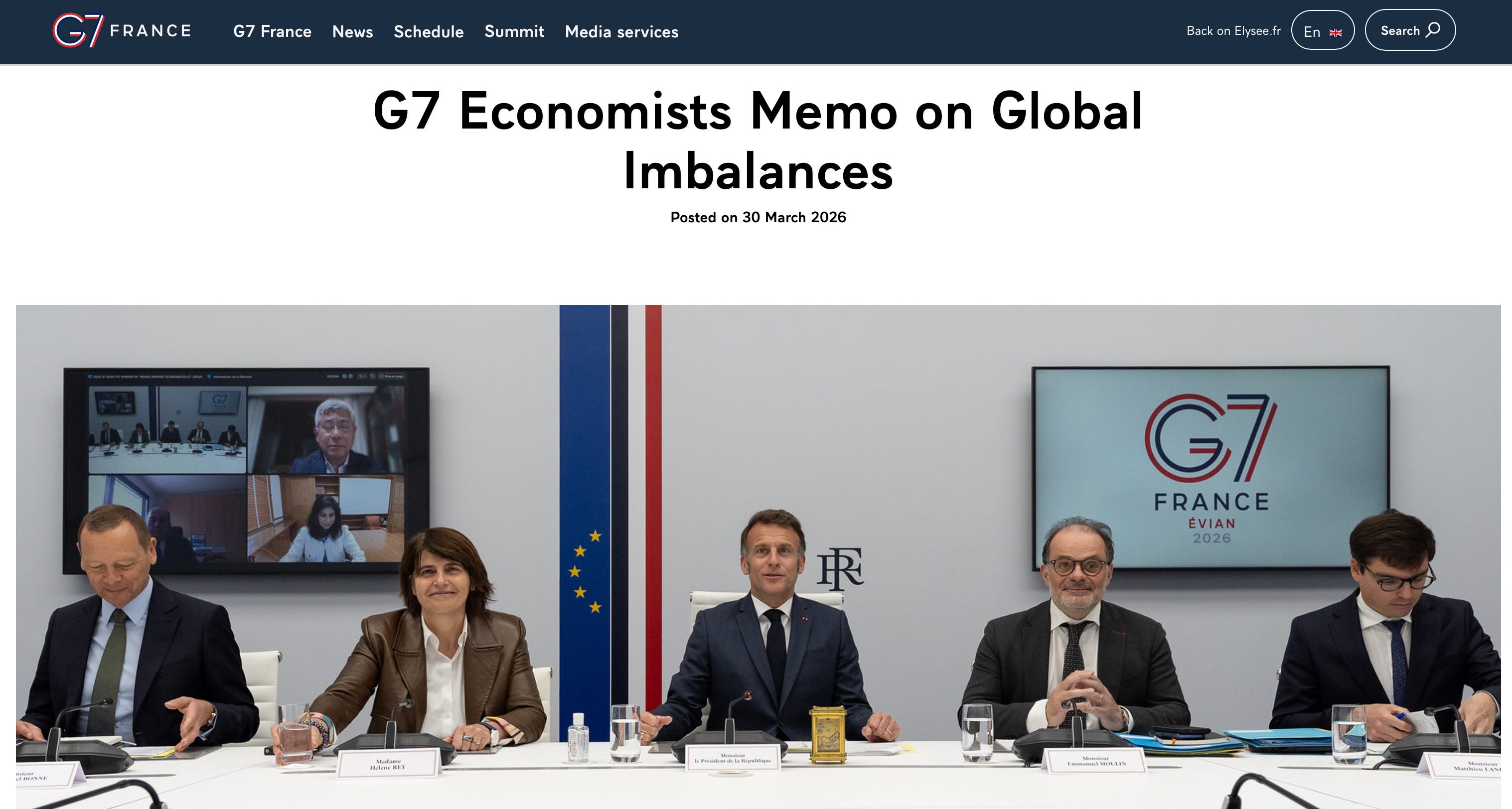
The G7 (Group of 7) economic confab is on in the lovely Evian-Les-Bains, France. A group of distinguished economists produced a report on just what problems the world economy faces and what the G7 should recommend. (Front page here, report here)
The theme:
our global economy is threatened by deep imbalances,
“Imbalance” is usually an economic fallacy. Everything balances. It usually balances somewhere that someone doesn’t like, but that’s a different thing.
What are these “imbalances” and other problems for the G7 to solve?
Predatory competition, industrial overcapacity, underinvestment, excessive debt and deregulation, the retreat of international solidarity, and weak private investment in developing countries…
“Predatory competition?” The very first economic problem in a long report is a longstanding economic fallacy—that large companies drive out competitors and then raise prices to become permanent monopolies. Yeah, Ford and GM locked up the world’s car market in the 1950s. Look up a minute, especially in France. Do you see unrestrained competition among titanic industries, hell-bent on “predation?” Or do you see a vast expanse of government-protected crony-capitalist oligopolies, interspersed with a few upstart companies trying hard to sell you better products? How is the new iPhone “predatory?”
Trade and Growth are good. But for the report, growth must be “balanced,” and trade “reciprocal” What does that mean?
“Overcapacity, underinvestment?” Those seem just a little contradictory, don’t they? If you’re underinvesting, it’s hard to get overcapacity. I presume that the overcapacity is not in the same place as the underinvestment, so it means investment isn’t going where the authors would like it to go. Perhaps capacity and investment are driven by crass considerations such as profitability, rather than addressing “imbalances” which somehow do not create profit opportunities. Likewise, could that “weak private investment in developing countries”—which are really the not-developing countries, of course—have something to do with the general economic dysfunction that makes investment unprofitable?
“excessive debt and deregulation.” Well, I’m on board with excessive government debt. But “excessive deregulation?” Really? In a report written by top economists? In Europe?
“the retreat of international solidarity?” Yeah, we’re not getting along these days, but how is that a problem diagnosable or remediable by economists?
Well, let’s read the report, “the result of several months of work by economists recognized for their expertise in international macroeconomics”
Trade and growth are good. Whew, no “degrowth” here. But only “balanced” growth and “reciprocal” trade. I never saw those in any economics textbook. What do they mean?
Growth is “balanced” when it is durable, resilient, and consistent with national security. Trade is “reciprocal” when it is mutually beneficial for countries.
All that hedging is a way of saying except we don’t like trade deficits. In economics, growth is growth. More is good. How can voluntary trade not be mutually beneficial? China’s not holding a gun to your head to buy that new bicycle. “For countries” must allude to some state interest different from the prosperity of the citizens. But this was supposed to be an economists’ report.
Finally we get to some actual international macroeconomics:
The rise of excessive current account deficits and surpluses reflects increasingly unbalanced growth dynamics in China, the European Union (EU), and the United States (US). China has chronically low domestic consumption, the EU suffers from persistently weak levels of productive investment, and the US has enduring fiscal deficits that are too large relative to economic conditions.
Leaving aside “excessive,”and “imbalanced” which economists have little capacity to measure, there is an important and under-appreciated good piece of economics here. A country, say China, that wishes to save more than it can profitably invest at home, must save by buying assets abroad. (One reason it might want to do that is that few people have children, so the country as a whole must save for its old age.) To buy assets abroad, China must put goods on boats, send them abroad, and take pieces of paper in return. Those pieces of paper promise that someday people in the US will work hard, put things on boats, and send them to China in return for our pieces of paper. Good luck with that, China. Vice versa, a country, say the US, that wishes to consume and invest but does not wish to save can print up those paper promises, and get the Chinese to send both consumption and investment goods. Eventually, though, we have to pay that back by putting goods on boats to support the Chinese in their old age. Or default, devalue, or say “terribly sorry, the stock market crashed.” If properly invested, repayment is more likely. If we simply consume the bounty, then repayment has to come from our children voting themselves big taxes. Good luck with that, China. (You can see a certain doubt in my mind just who is exploiting whom in this game.)
So trade deficits (and more generally current account, which includes goods and services) are balanced by capital account surpluses. “Unbalanced” is an oxymoron. Current-account deficits reflect consumption and savings decisions, not “predatory competition,” tariffs, industrial policies, subsidies, and all the other microeconomic distortions that privilege one exporter vs. another. At least all those economic fallacies, so common in the US today, are absent.
International economists used to worry about the Feldstein-Horioka puzzle: Why did countries, in 1980, largely finance investment from their own saving rather than borrow abroad? Why were current-account deficits and matching capital-account surpluses so small? Trade opened. The world started to look like our model. And now it becomes an “imbalance” needing “policy makers” such as the worthies at the G7 to intervene.
Positing that somehow China’s desire to save rather than consume is “excessive,” what do our G7 advisers propose? “Rebalancing growth” of course, in an endless parade of passive verbs:
Addressing global imbalances [euphamism for trade deficits] requires rebalancing growth…China’s growth can be rebalanced by increasing ‘investment in people’ as prioritized in its 15th Five-Year Plan. This calls for public support for healthcare, safety nets, repairing balance-sheets damaged by the property market crisis…
I can just imagine what a good belly laugh Xi Jinping and his buddies are having at that one. So, dear Europe, you bankrupted your governments with welfare states that provide unaffordable health care, pay money to people not to work, pay retirees full salary for 30 years, supported by non-existent children, and bail out anyone whose “balance-sheet” got “damaged” by a speculative investment, all to artificially subsidize consumption. In the process you destroyed growth as well as pulled in our exports. You really think we are dumb enough to follow you down that road to stagnation, voluntarily, all for “international solidarity?” Ha ha. (Allusion to the wisdom of five-year plans by economists is even curiouser.)
More deeply, where is the market failure? I know how we distort our economies to consumption, but how is China doing the opposite? Ultra-low rates at state banks do the opposite. And, in the end, why do we care? Yes, politics hates trade deficits these days, and has been gung ho on mercantilism since the 1500s. Is that any reason for economists to advocate “rebalancing?”
The European Union should raise its growth potential by implementing key recommendations of the Draghi report, including deeper integration of goods and services markets to increase scale, and further capital markets integration to expand long-term risk capital. The United States can strengthen growth resiliency by reducing its public deficit and reinforcing financial stability. Policy measures to put public debt on a sustainable path are essential.
Yes, EU growth is a real problem. And the Draghi report outlined some important steps. I’m all for deeper integration of goods and capital markets. But ahem, one of the major recommendations of the Draghi report is to unbundle the mass of regulatory red tape and legal vetocracy that stymies getting anything done in Europe, along with job protection and other policies that stop risk taking. Why the silence? Oh, yes, “excessive deregulation” is Europe’s problem. What about Europe’s catastrophic energy policies, that shipped carbon-emitting industry to China? Nobody’s “global imbalance” forced that one. Thank goodness at least they do not sign on to Draghi’s recommendation for debt-financed public investment, like the brilliant Superbonus.
Yes, whatever “resiliency” means, US fiscal and financial policy are a mess. But it’s easy to say “fix them.” Duh, these have not gone un-noticed. How you fix them matters. Raising marginal tax rates to European levels will help to produce European growth.
But listen to the sound of silence here. If you don’t like trade deficits, and find, correctly, the root in China’s saving and our consuming, maybe our domestic policies that subsidize consumption and discourage investment are just a little bit at fault? The US and EU borrowed money, and sent checks to voters on a consumption binge. We heavily tax the return to capital, and then wonder why people consume rather than invest. Doctor heal thyself, before recommending that the patient take your own poison.
They say the problem with France’s economy is that the French language has no word for entrepreneur. It certainly has a lovely word for dirigisme, in full flower in the report’s discussion of financial affairs:
Financial sector imbalances, especially those involving large gross flows, maturity and currency mismatches, and excessive leverage, can generate systemic risks.
Financial sector imbalances should be addressed through prudential policies and enhanced IMF and Financial Stability Board (FSB) surveillance, improved data collection on cross-border exposures of non-bank financial intermediaries (NBFIs) and on crypto assets, system-wide stress testing that incorporates international linkages between banks and NBFIs, and international cooperation on emergency liquidity provision.
The IMF plays a central role in assessing excessive imbalances and conducting bilateral and multilateral surveillance. Continued close cooperation and information sharing among the IMF, WTO, and FSB will strengthen the global capacity to manage both macroeconomic and sectoral imbalances. Complementary data efforts and analysis on non-market practices by the OECD and on cross border exposures by the BIS are highly beneficial.
There you go with that “imbalance” again. I buy a lot of chocolate at Whole Foods. Is that an “imbalance?” How do you measure? Who is to tell? “Large gross flows” are an “imbalance” just because they’re large? Why do firms take on “currency mismatches” and “excessive leverage” if not because they know they’ll get bailed out in the end? Define “systemic risk,” please, and no, it does not mean somebody might lose money.
“Prudential policies” “surveillance” of anything financial, measuring “international linkages,” means applying the Basel/Dodd-Frank apparatus that so spectacularly failed in SVB, in 2020, in Credit Suisse, on an international scale. “Emergency liquidity provision” means Uncle Sam and the ECB to print money every time someone loses money. Isn’t the screaming “vulnerability” and “imbalance” in the Eurozone especially exactly the moral hazard that the ECB’s failed supervision and “emergency liquidity provision” leaves it on the hook for massive sovereign debts? (Selling my book of course, here.)
And of course, who is to do that? The alphabet soup of international organizations, straight off a string of policy successes. I guess they will write more reports like this one. With AI to help, the stream of drivel should expand mightily.
OMG, here it is a few thousands of words in and I’ve only gotten through the executive summary. It doesn’t get better.
*****
Thoughts
What do we learn? For one, I learn the sorry state of the G7 and related international policymaking blob such as the IMF, WTO, FSB, and OECD. Hoover is undertaking a large “commons” project to re-envision international cooperation in economics and national security. It presumes that these sort of organizations and events have outlived any usefulness. I find that presumption amply confirmed.
This post is painful to write. The economists whose names appear on it are truly outstanding. Many are also friends, or at least were until about 5 minutes ago. I want to shake them. What are you doing? How did you lend your good name to this vapid report?
The report brims with between the lines euphemisms, many of which I point out by taking the literal language seriously. “Predatory competition?” yes, I know you mean China and competitive mercantilism. “International Solidarity?” We all know who you’re talking about.
This report violates everything that economics ought to be. Back in Econ 1 you were taught that an “imbalance” or other problem needing policy intervention had to stem from some market failure, or perhaps the unintended consequence of previous interventions. Where do all these “imbalances” come from? No word. Does anyone have the competence to understand the international economic and financial system, diagnose and measure “imbalances?” Hayek is rolling over in his grave. Economists don’t know the gross flows of tomatoes, or the imbalance between the strawberry and blueberry markets. The report pretends to some deep technocratic understanding, of which the fancy words are descriptors for laypeople. No, it’s all made up.
You can tell that the answer and desire for expanded policies drove the question, from all the missing elephants in the room: Western regulation, welfare state, tax disincentives, subsidies and worthless industrial policies. Reforming the current mess and putting out our dumpster fires is so much harder than advocating brave new policies from ever expanding international organizations.
It looks like my friends and colleagues were given a political agenda, “imbalances,” and told to support it. They should have said no.
If you enjoyed my little rant, read Bob Lucas’ masterful review of a report to the OECD in 1977. Bob inspired me long ago. I do not come close to Bob’s masterful style or withering analysis. But as for the alphabet soup economic policy discussion, well, plus ça change, plus c’est la même chose. You will be surprised at just how little things have changed in international Marco policy discussion.
They lost me at "Trade is 'reciprocal' when it is mutually beneficial for countries." We know trade us mutually beneficial because otherwise the parties would't do the trade! (Presumably by referring countries instead of individuals (and thereby making in a category error) they mean to refer to trade that makes some third parties within a country worse off. But it would be silly to say that, so they don't.)
I have little doubt you are quite right in your criticisms.
But the “excessive deregulation” point is SO ridiculously obviously idiotic that I couldn’t handle paying attention to the rest.
I actually do kinda sorta understand how these guys have a shred of credibility on the rest, even given the idiotic stuff that I surely agree with JHC on that they are wrong on almost all of it.
But “excessive deregulation”?!?