

I just posted a draft of a short book with this title (click on the link for the book draft), resulting from the Karl Brunner Lecture I gave last fall. (Slides for the Brunner Lecture here.) It covers fiscal theory through the eyes of many episodes including the recent inflation and zero bound era. It also summarize work I’ve been doing since trying to figure out a basic theory of how central banks might lower inflation going forward by raising interest rates. Believe it or not, we do not have such a theory. The foundations of monetary economics are wide open.
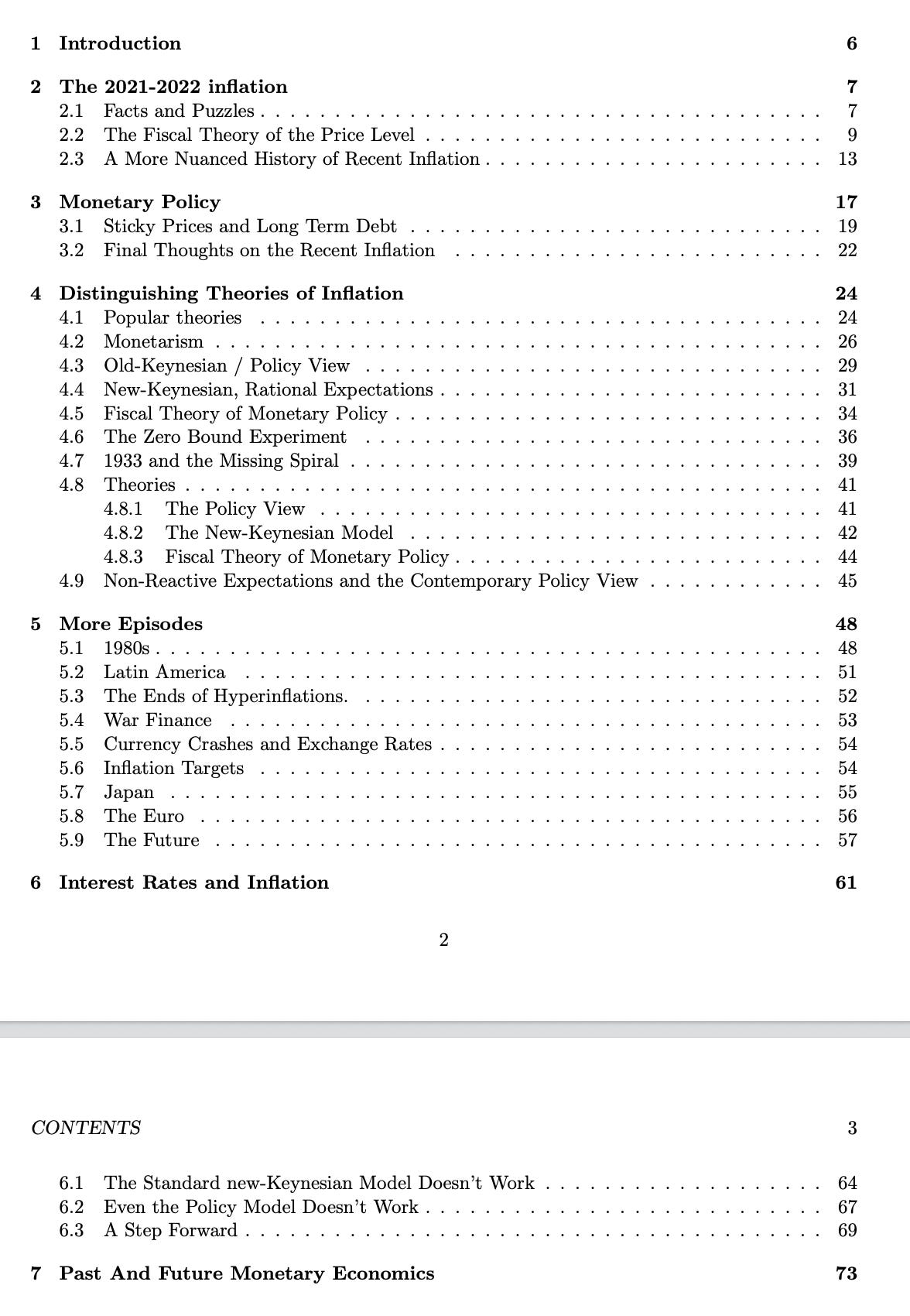
Here is a table of contents to whet your appetite. Comments welcome, it needs one last big revision before I turn it in to the publisher.
I realize I never posted the actual lecture. If you like videos, here it is.
Thank you for sharing the draft of Inflation and inviting comments before you send it to the publisher. I watched your lecture from last February last night and I read your draft. I wanted to offer some initial thoughts while they’re fresh.
First, congratulations. I think this manuscript succeeds at something that has been missing in the inflation debate: a coherent, integrated framework for thinking about inflation under interest rate targeting and fiat money institutions. The combination of fiscal theory with a stripped-down New Keynesian mechanism is especially powerful. It gives readers a complete model — not just a valuation equation, not just an IS/Phillips structure — but a closed system in which interest rates and fiscal backing jointly determine outcomes. That is a major contribution in a short book.
The treatment of 2021–2022 is the intellectual centerpiece. Your back-of-the-envelope calculation comparing the unexpected fiscal expansion to the magnitude of unexpected inflation is particularly effective. It moves the argument from rhetoric to arithmetic. The corporate valuation analogy also works extremely well. Framing government debt as a portfolio whose value must equal the present value of expected surpluses makes the mechanism intuitive, even for readers outside macro.
I also think Chapter 3 may be the most important section of the book. The “unpleasant interest rate arithmetic” result — that interest rate increases without fiscal adjustment can only move inflation intertemporally — is both unsettling and clarifying. It forces the reader to confront the coordination problem between fiscal and monetary authorities. The long-term debt channel is handled cleanly, and the logic is much easier to follow here than in longer technical treatments.
A few constructive suggestions:
1. Expectations and timing. The fiscal story for 2021–2022 is plausible and coherent, but critics will ask: when exactly did expectations of non-repayment shift, and how do we know? You discuss the change in rhetoric and policy direction in early 2021, which is helpful. It might strengthen the argument to sharpen the timing dimension slightly — perhaps by tying it more explicitly to market measures of long-term inflation expectations or debt maturity structure. Even a short paragraph clarifying why 2020 deficits did not immediately produce inflation would make the narrative harder to dismiss.
2. Policy implications of the interest-rate result. The conclusion that central banks cannot fully control inflation without fiscal cooperation is extremely important. You state it clearly, but the institutional implications could be pushed a bit further. The reader is left sensing that inflation targeting may depend implicitly on fiscal backing — which is a powerful insight. A slightly stronger concluding treatment of fiscal-monetary coordination (or the absence of it) would elevate the policy impact of the book.
3. Tone and persuasion. The manuscript is admirably direct. In a few places, however, the rhetorical edge may distract from the argument’s strength. Since this is positioned as a broad distillation for policy professionals and nontechnical readers, a slightly more institutional framing (less administration-specific language) might widen its reach without softening the substance.
4. Zero-bound and QE contrast. The comparison between the 2008–2015 period and 2020–2022 is one of the cleanest quasi-experiments we have. You touch on this, but I think it deserves slightly sharper emphasis. The contrast between large balance sheet expansions without inflation versus direct fiscal transfers with inflation is one of the book’s strongest empirical distinctions among theories.
Overall, I believe this manuscript could become the clearest short statement of fiscal-monetary regime thinking under interest rate targeting. It is rare to see the pieces assembled this compactly.
I appreciate the opportunity to read this at such an important stage.
Thanks for this!