

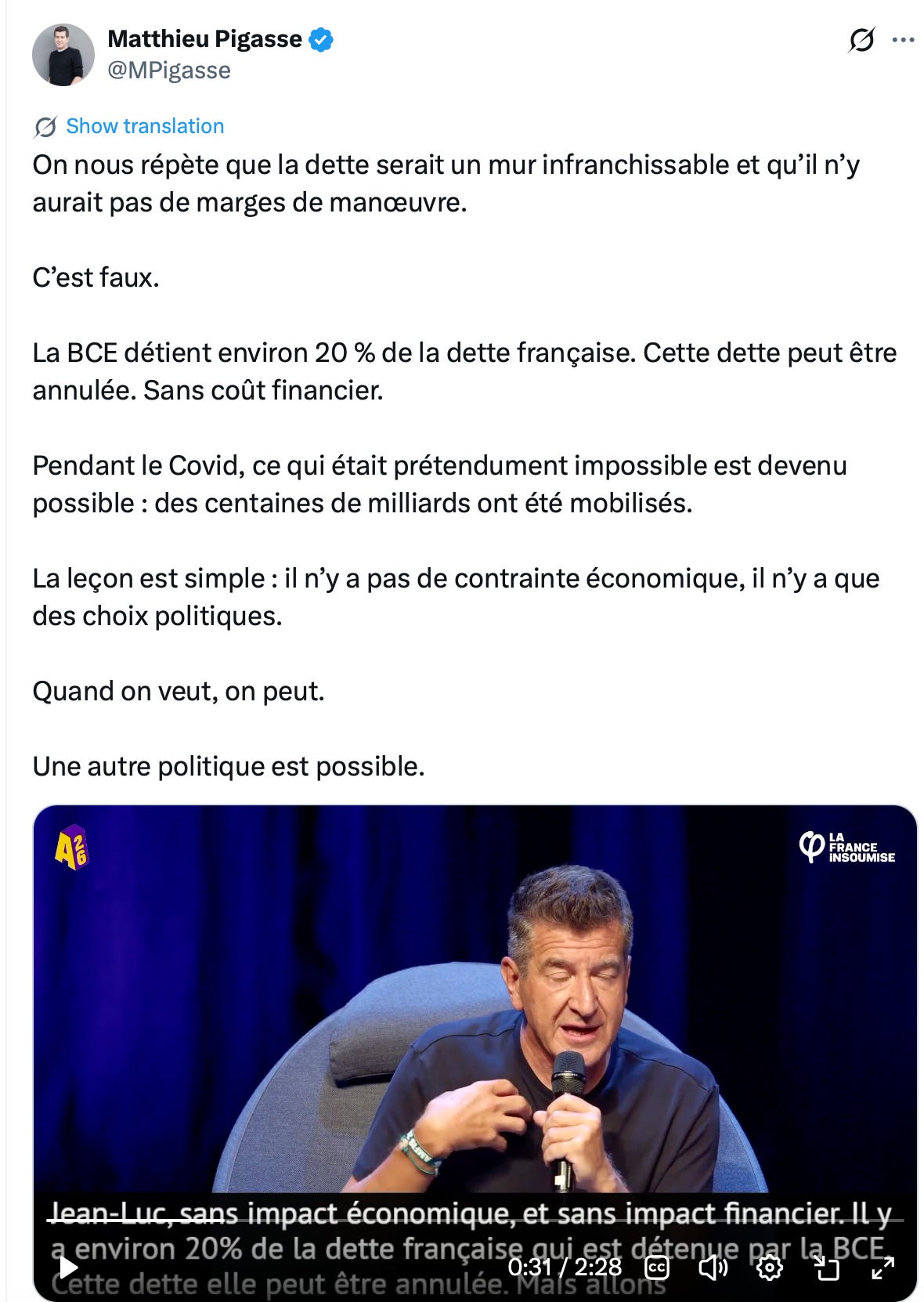
An interesting brouhaha has broken out in France, lately famous for reinvigorating the idea of wealth taxes: The French government should default on (“annul” “cancel” — the left is great at euphemisms) its debt held by the European Central Banks. Voilá. Disparu. Without any financial or economic cost!
Try out your high school French on the lovely video by Mattheiu Pigasse. It really is beautifully done. Short, clear, eloquent, hits all the arguments.
This affair is particularly interesting because the conventional macroeconomics and central bank view is hard pressed to explain just what’s wrong. Try this response by Olivier Blanchard, brilliant theorist and doyen of French macroeconomics. He explains that interest paid by France to the ECB is returned by the ECB to France, concluding that the default would have “no effect.” “… annuler la dette francaise detenue par la BCE n’aurait aucun effet.” I think Blanchard means no fiscal effect, but not that doing so would have an inflationary effect. And he left out the main issue, default on the principal payments.
You do smell a rat, no? If this works, why not have the ECB buy up the rest of French debt first, and then cancel the whole thing? And Italy, Greece, Spain, everyone but pathetically thrifty nordic countries who have some weird moral attachment to repaying their debts. Why not borrow even more, hand out free houses and cars to every voter, and then have the ECB buy and default? The euro system holds over a trillion euros of gold reserves. There literally is a Scrooge-McDuck pile of gold in the ECB’s basement. Why not just mint those into coins and pass them out? That sure would be popular!
Well, obviously no, but just why not?
Pigasse knows the obvious objection: it might cause inflation, just like 2021-2022. But no, he says. The big deficits happened in 2020, while inflation started in 2021. (Anytime someone refers to deficit spending as capital being “mobilized,” watch your wallet.) And everyone knows that inflation was due to “supply-chain shocks,” “energy shocks,” and so on, not unbacked money and debt.
Here he deftly exploits the gaping hole in today’s central bank and policy view of inflation. Much of the Fed and many macroeconomists also blame the 2021-2022 inflation on “shocks,” not massive deficits or the Fed and ECB’s multi-trillion purchases of those debts. More deeply, the standard policy view holds that inflation comes from the Phillips curve: from “tight” labor markets, from expectations, and from nebulous “shocks.” So talk down expectations, don’t worry so long as unemployment doesn’t get too low, pray for no “shocks.” And in the end the ECB can always control inflation by raising interest rates. If your intellectual framework doesn’t have a place for backing, off down the slippery slope you go.
So who cares if the central banks hold any assets? If nobody cares, then this French Magic Money Tree really does work. And we can repeat the post-covid green-new-deal “inflation reduction” debt financed blowouts without fear. Just let central banks buy the new debt again.
People are apparently happy to hold the approximately 4 trillion euros outstanding, the argument goes, and they would be just as happy to hold those euros whether or not the ECB holds any assets matching the euros. They probably have no idea what’s on the ECB balance sheet anyway.
Well, let’s work through what obviously must be true—that assets matter. Yes, people are happy to hold the current supply of euros. And perhaps monetarists are right, they do so because of the liquidity value of money, having nothing to do with its backing. But suppose one day that inflation breaks out again. People don’t want to hold so many euros, and try to trade them for goods and services instead. And this time, central banks want to do something about it. So, the ECB has to soak up some of that money. But with what? When the central bank has assets, government bonds, it can sell the government bonds, take back the excess money, and stem the inflation. What will the ECB do if it has no assets to sell? Well, then the eurozone governments have to give the ECB assets that the ECB can in turn sell in order to soak up euros. They have to tax their citizens. The euro is, ultimately, backed by taxes. The government bonds that the ECB holds now are just claims to those taxes set aside ahead of time so we know for sure the ECB will be able to do it.
Or, take a more current view that the ECB will stem inflation by raising interest rates. The ECB must then pay higher interest to banks. Where do the interest payments come from? The ECB might just print ever more unbacked euros to pay interest on the unbacked euro deposits it has now, but you can tell that won’t last very long. The ECB has to collect interest on its asset holdings, or again receive fiscal transfers from member states to do it.
So, yes, a French default to the ECB ultimately must mean either everyone else in the eurozone ponies up tax revenues to restore the ECB balance sheet, or inflation, which taxes everyone else’s money holdings. There is no magic money tree. Printing money is not “mobilizing” capital. Default is default, and somebody loses. And if you don’t have a view of inflation in which central bank balance sheets matter, you’re missing something crucial. If you don’t have a view of economics in which French taxpayers ceasing to pay interest and principal on their bonds means somebody else loses exactly the same amount, either in real terms or via inflation, (and especially in a full-employment economy) you’re missing something important.
Have I mentioned lately that there is a really wonderful book that explains the fiscal foundations of the euro in great detail? And only $35 list price!

In related news, and thinking also about the US interest rate surge, do you notice who is really quiet lately? That would be Kevin Warsh’s Federal Reserve. Interest rates are surging and we are not hearing the usual complaint about dysfunctional or fragmented markets from the Fed. The Fed is not buying US treasury bonds to hold down long-term interest rates. That silence is significant. The first purpose of central banks is to commit against monetizing debts.
“If nobody cares, then this French Magic Money Tree really does work.”
Thank you for using this term whose acronym would also be MMT, as that is precisely what this sounds like, except perhaps slightly stupider and even more obviously wrong than what the Modern Monetary Theory-types advocate.
Isn't this a more relevant question for the Fed, since it is part of the US government? The Fed "buys" Treasury debt by writing up some bank's reserve balance. The Fed's balance sheet gets bigger and the Treasury's gets smaller, but total US obligations are unchanged. In fact the Treasury just announced something quite similar: It will "buy" long Treasury debt and pay for it by issuing more bills. Why couldn't Bessent take trillions off the Federal debt by cancelling the bonds held by the Fed and replacing them with some vague capital note that would not count as debt?