

This intriguing substack by André Lara Resende is causing an uproar in Brazil. He advocates that the Brazilian central bank lower interest rates in order to ease interest costs on the debt, and that this will not spark inflation. I don’t agree with everything in the substack, but it is economically sophisticated and poses a coherent argument.
Disclaimer: I don’t know much about Brazil, the Brazilian economy, and even less about Brazilian politics. I’ll focus on general principles.
The situation
Brazil has an interesting fiscal and monetary situation. The primary deficit is not large, currently under 1% of GDP. Debt to GDP is large, about 80%. Interest rates are high. The overnight rate (selic) rate targeted by the central bank is 13.75%. The 10-Year government bond yield is 15.4%. Current inflation is 4.5%, with a 3% target. Real GDP growth is moderate, 2.5% and forecast to decline.
Resende:
The core of the fiscal problem lies in debt servicing. Everything else is secondary.
Yes. If inflation remains 4.5%, that means that real interest rates, and thus real interest costs once debt rolls over, are around 9%-11%. Times 80% debt/GDP, that means 8% of GDP deficit from interest payments alone. With even 3% real GDP growth, debt/GDP will grow 5% per year in the absence of any deficit at all. So much for r<g. In Brazil, r>>g.
It doesn't take much analysis to conclude that the situation is unsustainable. The explosive trajectory of debt in relation to GDP must be stopped as soon as possible.
In some ways, Brazil is one step ahead of the rest of us as interest costs start to consume the budget.
Lower interest rates alone, with no change in primary deficit, would indeed substantially improve Brazil’s fiscal situation. The key question is whether the central bank can make that happen just by lowering the interest rate target. The obvious complaint is that lowering interest rates might make inflation zoom up again.
Many politicians including our own President Trump have wished for a magic wand to lower interest costs on the debt. Is the central bank that magic wand? One’s instinct is no — you can’t wave a wand and lower your grocery prices, and you can’t wave a wand and lower your borrowing costs. But it is, in fact, not so obvious.
The proposal
Resende’s proposal:
A new National Fiscal and Monetary Council (CFMN) would set fiscal and monetary targets for a period of four to five years….Inflation targets would be announced jointly with targets for the basic interest rate. The central bank would commit to maintaining the basic rate within a range between the inflation target (3.0%) and the potential nominal growth rate, that is, the inflation target plus the potential real growth, which would currently be around 5.5% per year (3% inflation plus 2.5% growth). Only in exceptional cases, authorized by the CFMN, could the basic rate be below the floor – the inflation target – or above the ceiling – the potential GDP nominal growth – of the range.
To initiate the new fiscal and monetary regime, the Central Bank would announce a gradual reduction in the basic interest rate over approximately 12 months, to the potential nominal growth rate plus a temporary safety spread of 2%, that is, close to 7.5% per year. This safety spread would be periodically reassessed and gradually reduced until it is eliminated
(There is more on exchange rates, which I’ll get to later.)
Theory and experience
Some theory and historical analogies suggest it might work. Other mechanisms and experiences caution that it might not. As always in economics, just what is (and can be) held constant matters.
It certainly seems plausible, and I have written, that higher interest rates without a fiscal tightening to pay interest costs can cause higher inflation, or at least challenge the central bank’s inflation-fighting abilities. When the underlying inflation comes from fiscal problems, higher interest costs add fuel to the fiscal inflationary fire.
(The fiscal tightening need not happen right away. If the government can commit to repay the interest costs with even larger subsequent surpluses, the immediate interest costs are not inflationary. Thus, this mechanism is most important when fiscal inflation is already the problem because that fiscal space is absent.)
Well, logically, then lower interest rates without a fiscal loosening (that part is important) ought to lower inflation.
Eduardo Loyo famously interpreted previous Brazilian inflation experience in this way. In a time of high inflation and big deficits, higher interest rates with no fiscal change added to interest costs on the debt, and made inflation worse.
Well, if you like Loyo’s story (and I do), this is the same story with the opposite sign.
Even in classic “old Keynesian” adaptive expectations models, higher interest rates do not lower inflation unless fiscal policy tightens to pay interest costs, and vice versa.
Many economists subscribe to the multiple-equilibrium or unstable-equilibrium view of sovereign debt crises. Debts that are “sustainable” at low interest rates are “unsustainable” at high interest rates. So if investors get worried and demand a higher interest rate, the probability of default or inflation rises even more, and the interest rate goes higher still. Rate rises due to crisis fears can be a self-fulfilling prophecy. Conversely, intervention such as Mario Draghi’s “whatever it takes” can supposedly tip the economy back to the low-rate "sustainable” equilibrium.
Well, if lower rates alone can restore sustainability when Draghi is in charge, then they can do so for Brazil. (I don’t think this is what actually happened in Greece, but the point is the theoretical possibility. “Whatever it takes” came with some important reforms.)
The “neo-Fisherian” prediction of modern macroeconomic theory is, as Resende notes, pretty robust. Higher interest rates must go with higher inflation in the long run (neutrality) and forward-looking expectations mean that the economy is stable in the long run, so inflation must converge to the nominal interest rate plus a moderate real rate. This is not so much a fiscal-theory prediction as a forward-looking expectations prediction, and it occurs in Mike Woodford’s justly famous but decidedly non-fiscal-theory new-Keynesian models.
Lower interest rates might still raise inflation in the short run (Resende summarizes nicely). Governments might have to wait out a short-run surge, which is difficult. However, the main model of that negative effect relies on long-term debt and a sudden announcement that changes long-term bond prices. Resende points out that Brazil (like many countries on the fiscal edge) borrows heavily in short-term floating-rate debt, so the mechanism will be weak. He also prescribes a well-preannounced, slow and steady interest rate reduction which will not sharply raise long-term bond prices.
more than half of the debt is in LFTs, securities with returns linked to the Selic, the daily basic interest rate, and therefore with a very short “duration.”…if the debt is all indexed to the overnight rate – exactly as in the case of LFTs – reducing the interest rate does not increase the present value of the debt, so it does not cause an increase in inflation in the short run. Inflation immediately begins to converge to a lower level given by the interest rate.
This structure nicely avoids the long-term debt mechanism for a negative short run effect. I worry that there are other mechanisms. Maybe I’m just too unsure of myself to discard the doctrine that lower rates can raise inflation too quickly. Policy advice must peer into the fog of models we don’t have yet but suspect might be out there.
On the other hand, many governments have tried to hold down interest costs in the face of fiscal problems, and it usually does not work. War finance is the classic example. In wars, governments borrow, print, and spend a lot of money. Central banks hold down interest costs directly. They they force banks and others to hold government bonds at low rates, impose capital controls, and finally price controls. If inflation does not surge right away, it surges when price controls are lifted, or when the government makes the decision after the war not to fully repay the debt — for example, whether to return at parity after WWI and the Civil war. Covid was fought about the same way, with the same result. Milton Friedman, in his famous 1968 address, cited the experience of postwar interest-rate pegs in Europe, that fell apart in an inflationary surge. But those interest-rate pegs were put in place to lower interest costs on the debt, in a situation of intractable fiscal deficits. Turkey tried it too.
Put another way, when does lowering interest rates to lower real interest costs, which might work, spill over into financial repression to lower real interest costs, which won’t?
In the face of this evidence, I have always been leery of the proposition that one could exploit the Fisherian properties of rational expectations models, and lower inflation by lowering interest rates. The proposition requires solvent fiscal policy, and especially requires that the government does not raise spending, diverting the saved interest costs to other areas.
Resende’s argument is more subtle however. Since inflation at 4.5% is not a huge problem, by Brazilian standards, his main goal is not to lower inflation, but simply to put debt back on a sustainable path without raising inflation.
A stronger fiscal side is needed
My main worry concerns the fiscal side. Our theory says “holding surpluses constant,” and really “holding expectations of future surpluses constant.” To work, people must really have faith that, absent higher interest costs, Brazil would reliably pay down its debt with reliable years and decades of small primary surpluses — even if a crisis or recession comes in which Brazil needs to borrow more. But do people really trust that to last — and to turn in to surpluses someday?
Resende only notes that current primary deficits are small, 1% of GDP. Restoring the ellipsis above, the fiscal part of the proposal is
A new National Fiscal and Monetary Council (CFMN) would set fiscal and monetary targets for a period of four to five years. The fiscal targets would be based on rationalizing and simplifying revenue collection and operating and investment expenditures. Inflation targets …
Well, “targets” are nice. Politicians make them all the time. Then stuff happens. “Rationalizing and simplifying” would be great, along with eliminating waste fraud and abuse. When I think of the kinds of fundamental, institutional, fiscal reforms that stop inflations and resolve exploding debts, though, they are more durable, especially given Brazil’s history.
What can Brazil do to really commit itself to debt repayment? A constitutional debt brake works in Switzerland, but the Swiss are pathologically thrifty. The inflation-targeting reforms that successfully lowered inflation and helped government finances in the 1990s included fiscal and growth-oriented microeconomic reforms that were much more institutionalized than just “targets.” I think a more fleshed out version of fiscal and pro-growth reform would give this proposal a much better chance of working. Why is Brazil only growing 2.5%? It should be rapidly catching up to the US. (GDP per capita is $12,000 or $24,000 at PPP. It’s $90,000 in the US.) That would solve the fiscal problem quickly.
In all the ends of inflations, as in Milei’s in Argentina, fundamental fiscal and microeconomic reforms led or came with monetary changes. Fix fiscal policy and interest rates fall. The collapse of interest costs can have a “multiplier” effect on fiscal reforms.
There is no historical precedent for the Resende proposal. There is plenty of precedent for a package of reforms in which inflation stops, debt is paid, and interest rates collapse. But all three come together. That doesn’t mean Resende is wrong, it just means we’re out on a limb of theory that might work but hasn’t been tried.
He [me] makes a crucial observation: deficits and debts are only inflationary if associated with expectations that they may not be honored…everything depends on expectations, on trust in institutions.
Yes. Let’s get those institutions going.
Market doubts and fiscal worries
You can see fiscal doubts. The Real dropped by nearly 10% on the day of the election, not a sign of fiscal confidence
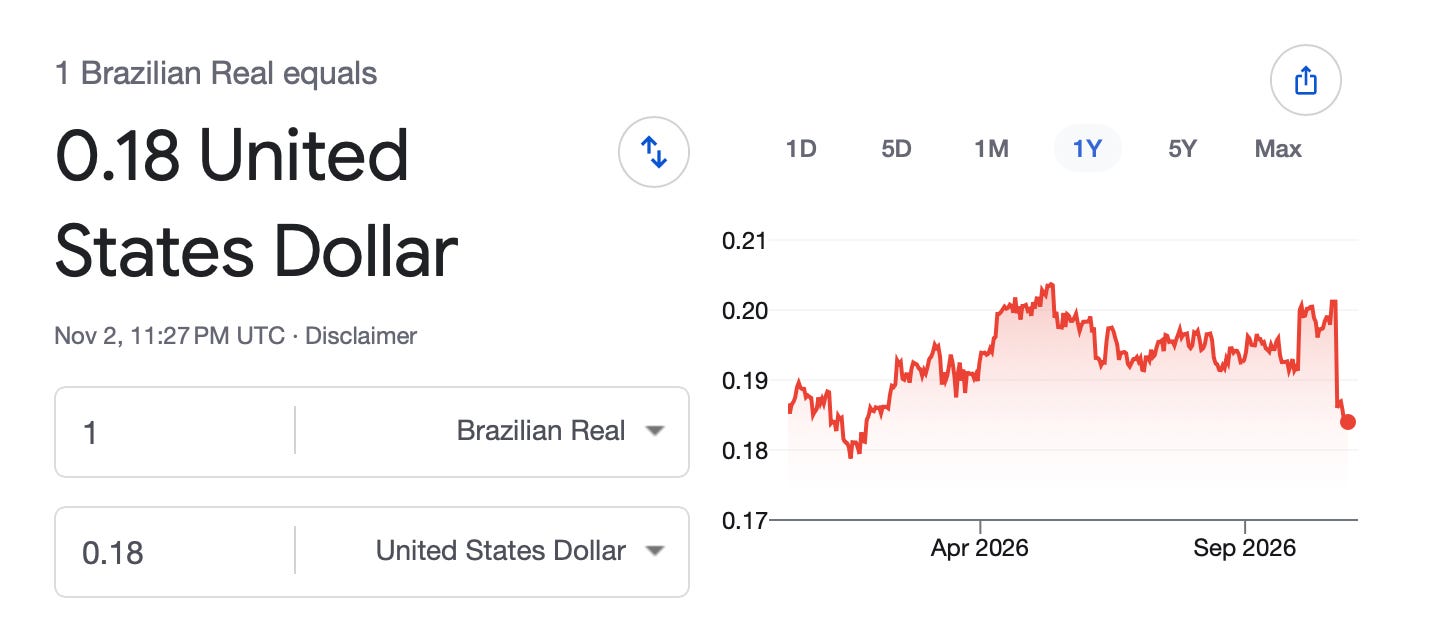
The 10-Year Government bond yield at 15.4% is higher than the 13.75% central bank rate despite forecasts of lower central bank rates. Some of that reflects inflation or default fears. The 5 year credit default swap is 141 bp, indicating (per Gemini) a 2.35% implied probability of explicit default, and larger if one factors in some recovery. S&P rates Brazilian debt BB. That Brazil is forced to borrow so much at floating rates indicates markets skittish about lending for longer periods, a classic sign of low faith.
Now, Resende might say, “my point exactly.” If the only reason to fear default or inflation is that high interest costs make debt unsustainable, then lowering the interest rate makes the debt sustainable. The currency will appreciate, long-term bond prices and CDS will crater, inflation will fall away, and all will be well.
Another way to put my worry, suppose that Brazil gains a gargantuan 8% of GDP budget breathing room from lower interest rates Will Brazil really not spend one Real more, or tax one Real less? My current model of government finances is that they, like ordinary people, respond to interest costs. The US and EU went on a spending spree of borrowed money when real interest costs went to about zero. It’s easy to say in theory “holding fiscal policy constant,” but for policy analysis you have to worry if that will be true.
Interest rate worries
A second worry is whether, in fact, the central bank can lower interest costs on the debt. Interest costs are real, and the central bank controls the nominal rate. Indeed, here Resende counts on interest rates not being Fisherian! Suppose a 5 percentage point lower nominal interest rate (from 13.5% to 8.5%) results instantly in 5 percentage point lower inflation — from 4.5% to -0.5%— holding the real rate constant. Well, then the real rate is constant, and interest rates on the debt have not fallen at all! Resende is counting not just that lower interest rates will not cause inflation, but that it will only cause a little bit of disinflation. Is less inflation that sticky?
More deeply, what are the determinants of Brazil’s real rate of interest? Is the current very high 9% (13.75% overnight rate - 4.5% inflation) real rates really just due to unimaginable tightening by the central bank, in the face of a “natural” rate of 2.5% or so? Or does the current real rate of interest also reflect a risk or default premium that will not so easily go away. Again, Resende’s Rule:
The central bank would commit to maintaining the basic rate within a range between the inflation target (3.0%)…plus the potential real growth, which would currently be around 5.5% per year (3% inflation plus 2.5% growth).
That rule presumes that the underlying real rate equals the real GDP growth rate (not worth a quibble here) but no default or inflation premium.
More deeply, can the central bank really make huge changes that will percolate across the term structure and allow the government to borrow at low rates more than overnight?
It is not disputed that the basic interest rate is set by the Central Bank…. The Central Bank announces and fully controls the basic interest rate, which is the main determinant of the cost of debt. It is the parameter that guides the entire term structure of debt. Other factors, such as uncertainty about its future trajectory, inflation expectations, and the political risk of debt, also influence price formation, especially for longer-term securities, but the basic rate is the main determinant of the cost of debt.
Well, maybe. That is the crux of the argument. Can the central bank really and durably set the real rate of interest?
The International element of the proposal is also interesting.
It [the central bank] would also announce that, if necessary, it will intervene in the exchange rate to mitigate any sharper depreciation, due to the possible reduction in the volume of carry-trade of speculative capital. With international reserves of more than US$350 billion, the Central Bank has ample ammunition for this. The two channels through which the reduction in the interest rate could put pressure on inflation in the short term are thus neutralized in Brazil: the fiscal channel, due to the short-term debt; the exchange rate channel, due to the reserves.
This makes less sense to me. Yes, currency depreciation leads to inflation, as imported goods cost more. But propping up the currency has a long and not very successful history in Latin America. The attempt must be a “sterilized intervention,” imagining that the central bank has two independent tools. If lower interest rates really are going to lead to lower interest costs, greater debt sustainability, and less inflation, the currency should go up, not down. (All the doubts that modern theory expresses about whether lower interest rates without fiscal changes raise or lower inflation have an exact counterpart whether lower interest rates without fiscal changes raise or lower the value of the currency.) If the exchange rate goes down, that’s a sign the policy not working. “Speculative capital” is a bit outside the model. This all reads that Resende is a little bit unsure, as I am.
Bottom line
Overall, the basic question remains whether it is lowering interest rates in free domestic and open capital markets, which novel economics uncovers as a possibility, or whether it is old fashioned financial repression which ends up exploding. I would rather see a coordinated fiscal, monetary, and microeconomic reform, which has worked many times in the past. And growth-oriented microeconomic reform is the most important policy anyway.
You may be frustrated that I don’t offer either a ringing endorsement or a stern disavowal. Policy advice is hard. You have to jump outside the model and think about what might be wrong or not held constant as you think. And I don’t like to give advice for countries that I don’t know too much about. Moreover, ideas are like children. They have to find their own way.
Note: This post will likely get updated as I learn more.
In Brazil, the central bank's mandate is to meet the inflation target. Since 2023, inflation has been above the midpoint of the target range in 45 months and above the upper bound in 21 months. It is currently above the upper bound.
The government could raise the inflation target, allowing the central bank to lower interest rates. If raising the target or cutting rates does not set off an inflationary spiral, it could be a win-win situation. Throughout this period, however, the current government has done nothing along these lines and has focused solely on complaining about high interest rates and calling for cuts — much like Trump does.
As for fiscal policy, it is unlikely that the government will pursue structural spending cuts. Roughly 90% of the federal budget consists of mandatory expenditures, while the remainder barely covers the cost of keeping the government running. The list of handouts and free benefits keeps growing. Brazil is gradually losing its demographic dividend, the social security deficit is widening, much of the economy is indexed, and the government is likely to continue granting real increases in the minimum wage, which in turn drive up other expenditures linked to it, such as pension and social assistance benefits.
There are also other factors adding fuel to inflation: increases in existing social benefits, the creation of new ones, and various credit programs, whether through the government acting as a guarantor or providing subsidized credit.
So yeah, it'd be lower interest rates WITH fiscal loosening.
Professor, with all due respect, let’s not forget Knut Wicksell (S=I).
If the natural rate of interest is ultimately determined by the real fundamentals of the economy - productivity, savings, time preferences, and the expected return on capital - what evidence demonstrates that Brazil’s natural rate stands at around 2.5% in real terms, rather than at a higher level?
Absent a convincing answer to this question, administratively setting an interest rate range of 3% to 5.5% in nominal terms risks conflating a desirable target for government financing with a sustainable equilibrium interest rate for the economy as a whole.