
AI regulation

I prepared two “weekly rants” on AI which will come out in a few weeks. The first responds to the “we must act now” open letter on AI spearheaded by Erik Brynjolfsson, who directs Stanford’s human-centered AI program. (I’ve corresponded with Erik, who is very thoughtful, welcomes discussion, and politely tolerates my snarky tone. Thank you!) The second responds to Governor Gavin Newsom’s executive order on AI. This essay is a bit fleshed out compared to the video version, and some people (me) prefer to read rather than watch videos anyway.
We must act now!

Recently Stanford’s AI center spearheaded an open letter that gained a lot of attention.
The admirably concise letter starts “AI could drive an unprecedented transformation of our economy…It could bring risks, including large-scale job displacement.” The letter concedes that AI might also “bring major gains in living standards.” (My emphasis in all cases. Elvis could rise from the dead too.)
I’m interested that “job displacement” rather than, say, cybersecurity, dangerous viruses, and so on lead the “risks.” As I’ve said before and will again, this is extremely unlikely. We’ve had 300 years of astounding innovation that substitutes machines for humans. The unemployment rate is 4%. 2.5 million people lose their jobs every month in the US. And 2.6 million get new jobs. New technologies create new jobs. And should it happen there is no need to “act now,” no cat out of the bag that can’t be remedied if and when it happens. Unfounded fears of mass immiseration are nothing new. Remember only 5 years ago the hue and cry that due to self-driving trucks all the truck drivers would be destitute? Economists should know better on both counts.
The letter then demands “Economists, policymakers and technology leaders must act now to understand the economics of transformative AI.” Well, I’m all for understanding, but economists don’t seem to need much prodding, given the flood of work on AI. Which is getting about as far as we usually do in speculation about the unknown. Economists can barely agree on minimum wages and taxes. Climate estimates are all over the map. “Subsidize our research” isn’t a potent call to arms.
But here’s the important part. “We” and especially those “policy makers” must also act now” to “build the incentives, guardrails, and institutions needed to steer AI in a direction that complements humans and benefits society. “
Over 250 prominent people signed the letter, including many famous economists, Nobel prize winners, historians, public intellectuals, and tech titans.
I wrote a scathing tweet.
You must be kidding. Act now, before anybody has any idea what AI will do? Act now, when the last sentence trumpets that nobody understands the economics of transformative AI? Thank goodness nobody thought it was their business to “steer” the steam engine “to complement humans and benefit society,” and avoid “large scale job displacement” of horse-drivers and sailing ship mariners.
Most of all, I reject the basic premise about how our government and society work. Where are these dispassionate a-political technocratic “policy makers” who know how to “steer AI,” to guide new technology let alone the ones we have? This is the crowd that “steered” our catastrophic Covid policies, and is now “steering” a trade war. Look what a bang-up job they did on “steering” energy. They’ve already killed AI in Europe. Let “policy makers” fix the dumpster fires of their social programs, building restrictions, appalling public infrastructure, broken tax code, and failing schools before they “steer” some vague AI crusade.
What happened to America, land of limited government, rule of law, and individual rights, where economic life is not run by “policymakers?”
What happened to basic economics, especially for economist signatories? To regulate, you document a market failure, and then you document the capacity of a regulatory body to address it without inviting an avalanche of cronyism and protection. You don’t “act now” before you have any idea what you’re doing.
This sort of catastrophizing has a long and sorry history. Only 5 years ago they wanted to retrain manufacturing workers to code. Now coding is dead, and everyone wants manufacturing. Think of the population bomb, the resource crisis, nuclear power, GMO foods, stem cells.
Cheer up. These letters come and go, leaving behind only a small stain on the reputations of their signatories and institutions. (I feel sorry for the Nobel Foundation, whose reputation slides each time its laureates, recognized for narrow scientific achievement, sign such statements with the Nobel name next to their own.) In 2025 Nobel prize winners signed an “unprecedented plea” for governments to develop “moonshot” technologies” to “avert a hunger catastrophe in the next 25 years.” (Hmm Maybe AI is that moonshot! AI+GMO foods+nuclear energy abundance fueling desalination and fertilizer production+1.0 kids/woman+swiftly declining global poverty and this looks like a pretty lame catastrophe.) In 2021 101 Nobel Laureates demanded “a Global Fossil Fuel Non-Proliferation Treaty.” 16 Economics Laureates wrote a letter decrying Trump in 2024. 23 endorsed Kamala Harris, warning—strangely for economists— that tax cuts would increase inequality, and the economy would fail. (They also decried tariffs, which I don’t like either, but we have to admit that the confident predictions of economic disaster under Trump have not panned out. Neither has great revival, but nobody staked his or her Nobel reputation on Making America Grow Again.)
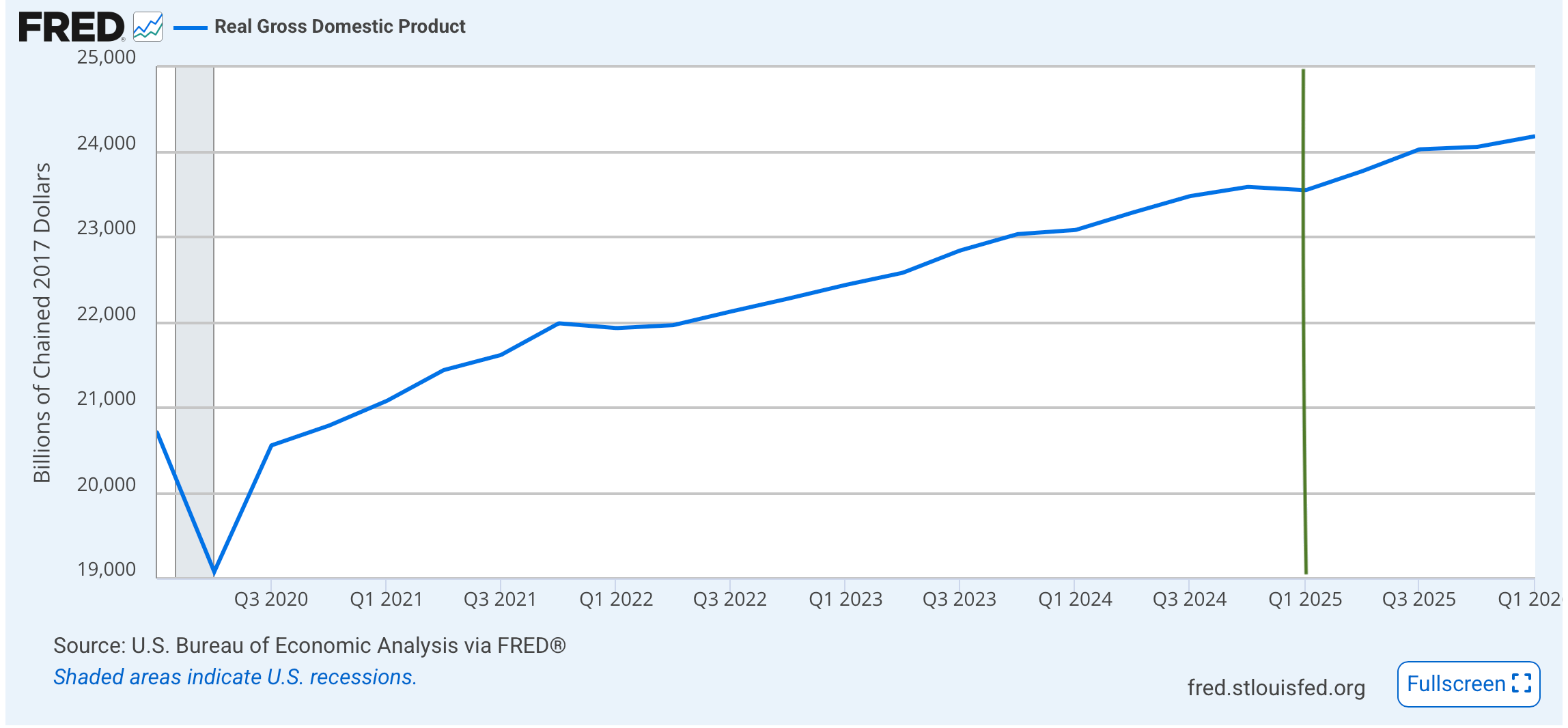
Two separate Nobel-economist letters predicted disaster should Javier Milei be elected in Argentina.
So this noise too shall pass. If you’re wrong about everything often enough, the world tunes out.
Gavin Newsom’s AI order
It turns out that “policy makers” AKA “politicians” don’t need open letters from us egg-heads to to “act now” on AI before anyone has any idea what it will do. They’re hard at work already.
To see what might come when “policy makers” act, let’s take a look at Governor Gavin Newsom’s executive order [N 6 26] on AI. Newsom is if anything in the sensible center of the Democratic Party, and given voter’s habit of throwing the bums out every four years, his order offers a glimpse of what might be coming.
The order also centers on the fear of widespread AI-induced unemployment — so far, I remind you, completely hypothetical and never seen historically.
The answers are straight from the 1930s. Even if they did any good then, AI unemployment is boom unemployment not great-depression unemployment. And the “whereas” section of the order long-windedly announces how many of these programs the state is already doing, which proves just how ineffective they are. California has an employment problem indeed. And it has nothing to do with AI, and everything to do with far too many labor market interventions already.
The order also directs the state to pay lots of people to write reports that nobody will read, including Stanford’s Human-Centered AI by name. (Congratulations!) It also directs government agencies to use AI to increase their efficiency. Maybe AI can write all the reports for free? AI agents to fill out thousand page environmental impact statements… I dream on.
Newsom demands a
review of policies and practices that provide displaced workers with a safety net, including severance…strengthening existing programs, including …subsidized employment programs…
Apparently the government needs to commission a review of its own programs. “Subsidized employment?”
expanding awareness of and enrollment in employment insurance programs..
Apparently the suffering masses need help to find free money.
identify, promote and enhance service opportunities,…for those experiencing long-term unemployment and other potential employment disruptions, connect unemployed workers to opportunities for training and upskilling,
Volunteering? Really? Displaced tech workers want to find meaning in life cleaning up highways? Add more job-training schemes to the dozens in place? (A second reminder on just how many job-training schemes taught manufacturing workers to code!)
review … the collective bargaining process,… including how worker voice is incorporated in adoption of emerging technologies,
More unions and “worker voice,” another novel idea from the 1930s. Maybe AI can bring back Pete Seeger and Woodie Guthrie. “They won all of the battles, but we had all the good songs.” Like useless firemen on diesel engines, and rules against automating ports, you know where that’s going.
support regions facing systemically high unemployment…
Unemployment in Fresno has nothing to do with AI. I can’t wait to see taxypaer support for the fashionable parts of San Francisco.
But I delay too much with snark. Here’s the crescendo, with revealing euphemisms
alter incentive structures…[to generate] AI development and deployments that advance the public good and address critical problems and emerging opportunities facing society.
Just think about what “alter incentive structures” means. Imagine the state’s definition of “public good” “critical problems” and “emerging opportunities.” Remember “vaccine equity?”
Finally towards the end we get the really good stuff:
public-private partnerships, voluntary or mandatory programs that direct a portion of revenue generated by AI companies
How would you like the governor to “direct” a portion of your salary? Want to do that “voluntarily?” That’s usually called taxes.
… securing dedicated access to computing power for research and development of AI that meets specified criteria for advancing the public good.
“Securing?” By means other than “buying.” “Commandeering” computer time? That’s interesting.
And finally, the kicker.
…expand and enhance worker ownership models…. employee-owned company structures… direct and indirect economic support for the formation of or conversion to employee-owned companies.
So that’s the answer to AI. The same warmed-over soft-communist idea that’s been running around faculty lounges ever since they had to admit that Stalin was a pretty bad guy. Worker-owned collectives. Run the company like a homeowners association. A well tried and well proven disaster. (UK, 1970s for example.)
So, what will the government do about AI if it responds to the “act now” call? Round up the usual suspects. The answer is always the same, it’s just the questions that change. AI poses an unprecedented challenge? Ramp up the New Deal!
The order includes a revealing sentiment.
workers and consumers should have a voice in the future of broad-based technological adoption;
Yes they should. And they do: via the products they choose to buy and use, and the companies they choose to work for and invest in.
This one sentence reveals so much — the view that people only have “voice” through the political process, which ultimately means by compulsion. It’s the antithesis of America.
****
PS:
I was also amused at the number of California state agencies mentioned that I had never heard of before. A partial list:
The Labor and Workforce Development Agency; the Jobs First Council; The Employment Development Department; local workforce development boards; Employment Development Department; California Volunteers; California Service Corps; Corps to Careers; Workforce Pell Grant program; Government Operations Agency; Office for Business and Economic Development (GO-Biz); Office of the Small Business Advocate (CalOSBA); The California Health and Human Services Agency; Office of Data and Innovation (ODI).
Well, I know where some of that “subsidized employment” goes!
Thank you for an excellent rant/article. To put it in a sentence, there is no problem so difficult that it does not have someone proposing a really stupid and likely ineffective of solution.
If I recall correctly (I read it 50 years ago), EP Thompson (one of the last intelligent communists) in the history of the English working class detailed the effects of technology change on the wealthier proletariat. In a few paragraphs at the very end, he did document that there was a recovery with time. Others have documented that it increased the general wealth of the working class with time.
It must be pretty lonely for you being one of the few sane people in California. Keep it up, we need you.
Well said. The conjuring of a supposed existential risk has become the favorite ploy to justify extreme government intervention. The Global Financial Crisis, climate change, Covid, AI: the familiar cry of "we're all gonna die" opens the way for outsized and misguided government action: endless QE, exploding government debt, net-zero mandates, widespread lockdowns... It's time to rediscover that when it comes to policy, less is more.