

[This is based on a second script for an upcoming “weekly rant.” Part 1 explored an interesting WSJ survey on how popular populist policies are.]
Affordability? It does seem a bit petulant. American’s standard of living is greater than any large country, and better than ever in the past. We earn on average 40% more than Europeans, British, Japanese, and Canadians. Poverty just hit an all time low. Health indicators hit an all time high. Inequality is falling. Some things have gotten more expensive, but other things are cheaper. Real wages are rising. Is a new multi-bedroom house in a nice suburb of a hot city expensive? Yes. But ask Europeans, who live in tiny apartments. What is everyone complaining about?
Well, the level of prices, as measured by the consumer price index, is 27 percent higher than it was just before inflation hit in January 2021, and 14% higher than it would have been had inflation been 2% that whole time. Though average real wages largely kept up with inflation, that’s not true for everyone. Many people who got new jobs got raises. But many people in old jobs did not. People on fixed nominal incomes or who want to buy houses or stocks are worse off. Inflation creates a lot of churn: some gain, some lose. Anyone who held government bonds lost about 14% due to inflation, and more as long-term bond prices fell.
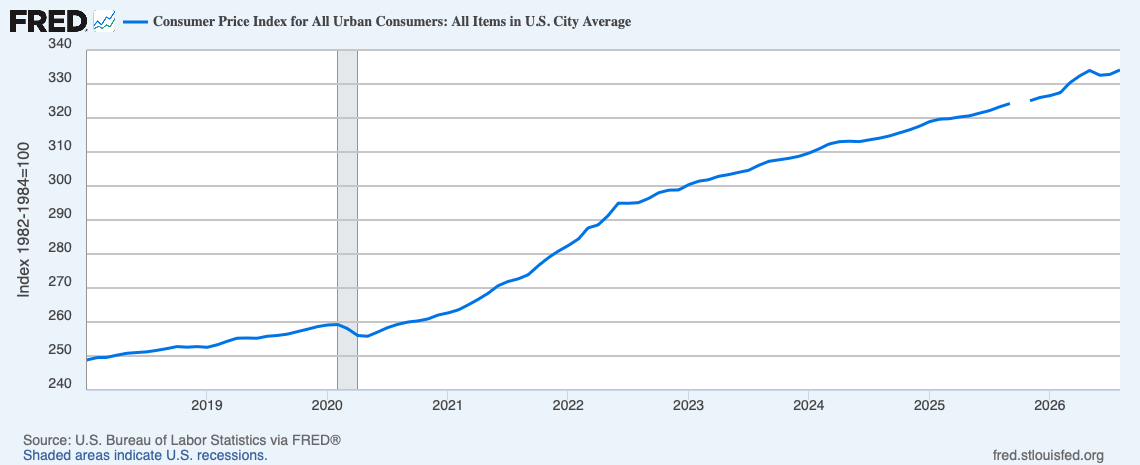
People hate inflation. People hate higher prices. You can lecture them all you want about real wages, about “transitory,” but people hate higher prices. That ought to be an important lesson.
Congress gave the Federal Reserve a “price stability” mandate. The Fed interpreted that mandate to mean 2% inflation forever. Prices should double every 35 years. And even that 2% is only a forward-looking aspiration. The Fed lets bygones be bygones. If inflation hits 10%, as it did in 2022, the Fed does not try to run inflation lower than 2% for a while, or even slight deflation, so that inflation will average 2% over time. The Fed does not even think of trying to bring the level of prices back to where they were. Even so-called transitory inflation means permanently higher prices.
The situation in Europe is even clearer. The ECB is given a sole mandate of “price stability.” The ECB has explicitly interpreted that mandate to mean a '“medium-term” forward-looking 2% target, with no correction for past mistakes.
But the peasants with pitchforks, also known as voters, are really mad about the level of prices.
I think the Fed, and Congress, should listen to that. What did Congress mean by “price stability?” An economic originalist would say, Congress meant a long-run steady level of prices, as had been the case for 200 years under the gold standard. The Humphrey-Hawkins act, though emphasizing employment, called for zero inflation by 1988.
Congress (and whoever is in charge in Europe) should clarify the mandate. Perhaps, “when we said price stability, we meant price stability!” If not, at least define a 2% target as a long-run average, and the Fed should correct its misses. Many inflation-targeting countries do that.
When I mentioned that sort of price stability, a prominent central banker dismissed it immediately: Nobody, the central banker said, would induce a recession just to bring back the level of prices.
Is a desire for price stability economically illiterate? I think not. I don’t think long recessions would be necessary. That’s pure Phillips curve thinking, that the only way to lower inflation is via high unemployment. Yes, unexpected deflations are associated with recessions, though causality often goes the other way, as in 2008 and 2020. But if everybody knows the Fed is committed, indeed legally bound, to slowly bring prices back to their previous level, or inflation back to a long-term average, people can fit that in their plans. The expected inflation term of the Phillips curve can move, not just the unemployment term. (The Phillips curve says that inflation equals expected inflation plus the effect of output or unemployment.)
Moreover, supply- and technologically-induced deflation, goods getting cheaper as wages stay the same, is fine. We’ve seen that in electronics, and AI may bring it more widely. Alan Greenspan reportedly favored “strategically” returning to zero inflation, and I think what he had in mind may be letting such technological deflation take its course.
In the 19th century, the US had slow steady deflation, as it brought the greenbacks back to gold parity. It was a period of strong growth. (Yes, there were some banking panics, but that’s another issue.)
Steady prices and a clear price level or average inflation mandate also implies a commitment by Congress to repay debt without inflation. In turn, that helps to remove fiscal pressures for inflation.
The people want steady prices. I think they have some centuries-old wisdom that the Fed, and Congress who gives the Fed its mandate, might remember.
Update:
A reader asks “it seems like you are advocating for a return to the gold standard as a way to control inflation. Would that be an accurate interpretation?”
Answer: No! Gold won’t work for the modern US economy. Inflation was very unstable under gold, though prices slowly came back to their original level. The price of Gold today is very volatile. That suggests that if we fix the dollar to gold, we’d get huge swings in inflation. However, since we no longer use gold coins, the tie between gold price and other prices we care about is gone. So I think pegging the dollar to gold would peg the gold price, but other prices would wander away. Finally, gold failed horribly in 1933. Gold is a good precommitment against inflation, but if deflation breaks out, the government is committed to raising taxes and cutting spending to redeem bonds in their gold value. Thus, big and undesired deflations can break out. I would like via a CPI standard to emulate the good parts of the gold standard without these defects.
Google for "inflation 1800 to present" and you get charts like this:
https://economics-charts.com/chart-of-consumer-price-index-1800-2005/
Inflation during wars, deflation afterwards, lots of little ups and downs, and very nearly 0% inflation overall until the Fed was created. Given my druthers, I'd pick 1800-1920 price stability over the rampant inflation instability we've had since.
I think this misses that inflation in specific sectors matters more to public perception of prices than 'CPI' or the metrics economists tend to use. Like Housing specifically has been well above CPI, and this makes many anxious because homeownership is a social step on the ladder to family formation. If housing prices had not spiked and never come down (not to mention the affordability impact of mortgages shooting to 6-8% from 4-5%) I suspect the public would have a reduced concern about inflation, even if some other area saw higher inflation. Groceries and fuel are a another specific subsector of inflation that have large consumer impact. If say, we had the same CPI and income to CPI matchup, I suspect there would be less popular backlash if that were say due to a rise in the cost of electronics, or the cost of home appliances, or maybe even the cost of automobiles. But inflation has been highest precisely in areas directly related to family formation, and that I think is a big part of why affordability is king until someone figures out how to actually reduce prices relative to wages in housing and other family formation related sectors.
Edited to say: this housing prices need to not just fall with respect to inflation, but specifically relative to wages, and wages specifically, not just income, as increasingly the housing market is dominated by upper quintile/quartile buyers who have substantial income from investment. Housing needs to be affordable to people who do not have investment income at places they can get work that can afford top pay them enough to afford the housing in the local market.