
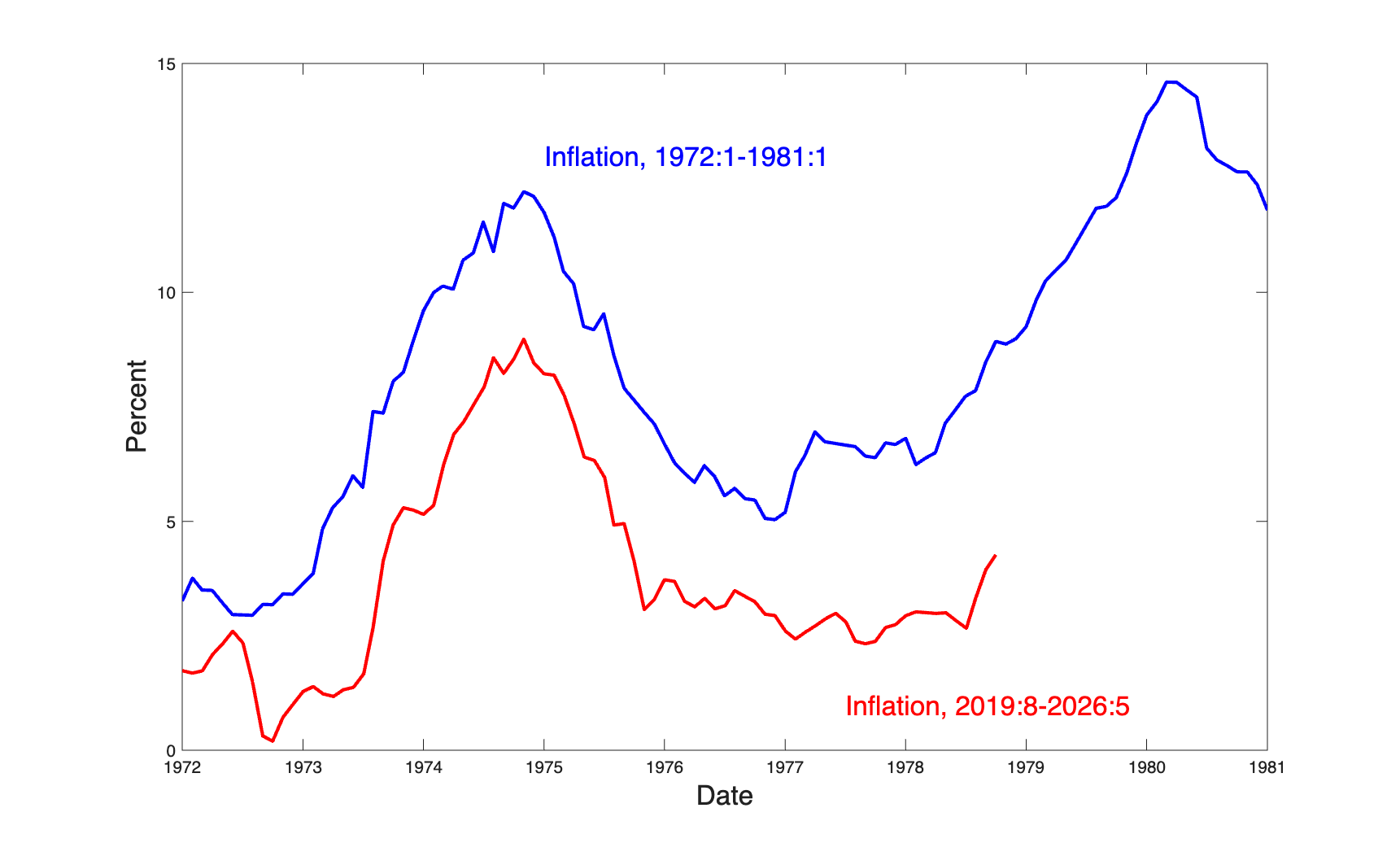
As the new CPI data came out hot, I can’t resist updating the comparison to the 1970s. Is it fair? Much is different. Much is not.

As the new CPI data came out hot, I can’t resist updating the comparison to the 1970s. Is it fair? Much is different. Much is not.
It's data fitting, John.
The data has been purposely selected to yield the pattern:
Δt = 47.5 yrs lag between the two sets of data;
n = 90 monthly observations.
X-Y regression
x: CPIAUCSL ∈ [1971.06.01, 1978.10.01]
y: CPIAUCSL ∈ [2019.01.01, 2026.05.01]
y = 0.0763 x^2 - 0.3141 x + 1.7366
r^2 = 0.91
What is the likelihood that other selections would yield similar correlations at other times? The analyst would have to run multiple 90 month data sets to demonstrate that the pattern depicted in the chart is not a random occurrence.
What are the economic factors which would lead to the observed correlation? Unless the economic conditions precedent have some common basis (model), one would have to conclude that the pattern depicted is simply the result of happenstance. What are those common economic conditions found in each of the two 90-month data sets? Your correspondent makes no claims of having analyzed the data to find those common economic factors.
Let’s compare real rates